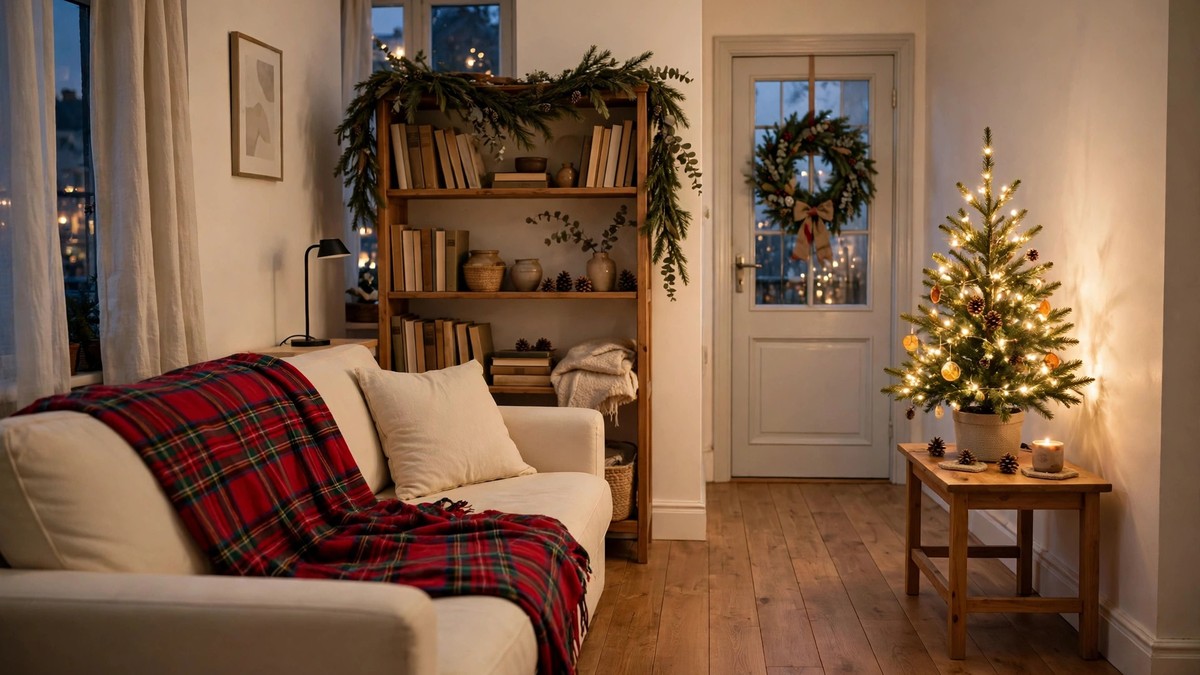
30+ Small Apartment Christmas Decor Ideas for Renters (No Ladder, No Holes)
Skip the 7-foot tree and the ladder, because small apartment christmas decor ideas for renters work best when they stay small, light, and damage-free. A tabletop tree on a side table, a garland on a bookshelf, and a wreath on an over-door hook give you the full Christmas look in under an hour. Every idea in this guide uses Command strips, tension rods, or freestanding pieces, so nothing puts your deposit at risk. You get the glow, the pine, and the color, without a single hole in the wall.
These 30 ideas cover the whole apartment, from the front door to the bedroom, and most cost under 30 dollars. You will find tree swaps for tight corners, table settings for two or ten, and wall decor that peels off clean in January. Pick three or four favorites, spend one Saturday afternoon on them, and your place will feel like Christmas the moment you walk in. No ladder, no drill, and no landlord phone call needed.
Tabletop Mini Tree
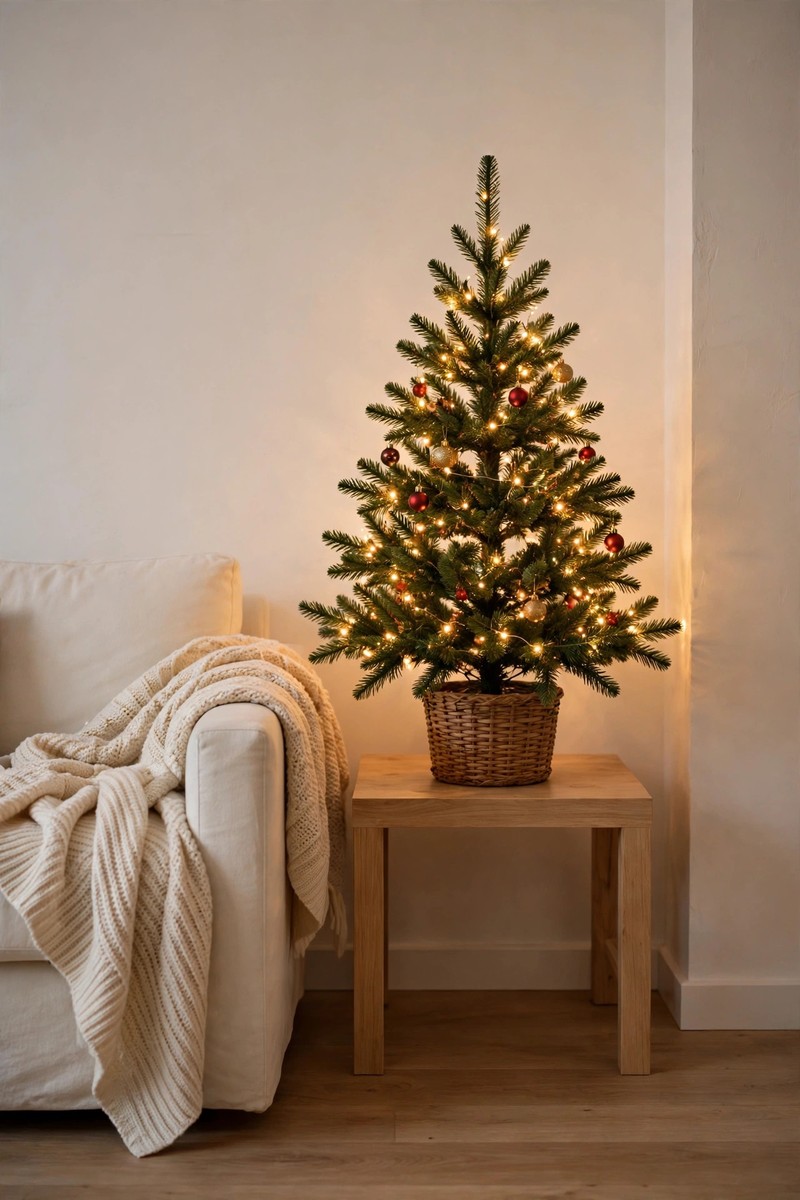
- A 2-foot tree fits on any side table and costs 20 to 40 dollars pre-lit.
- A woven basket hides the base and doubles as ornament storage in January.
- Keep ornaments under 2 inches so the small branches do not droop.
- A battery pack hides behind the basket, so no cord crosses the floor.
A tabletop tree gives you the Christmas feeling in about 2 square feet of space. Pick a 2-foot pre-lit tree, set it on a side table or a sturdy shelf, and hang 15 to 20 mini ornaments so the branches stay light and open. Most pre-lit tabletop trees cost 20 to 40 dollars, and a woven basket base hides the stand while adding a warm, rustic touch. Warm white lights beat multicolor on a small tree, because they make the room glow instead of shouting. Add a tiny star on top, and the tree looks finished in under 20 minutes.
Small trees shine in spots a full tree could never reach, like a kitchen counter, a desk, or a bedroom dresser. Place one in the room where you spend your evenings, and it becomes the centerpiece of the whole season for almost no money. Water is not an issue with an artificial tree, and the branches never drop needles on the carpet. When January comes, lift the tree into its box in one piece, ornaments and all, and the whole takedown takes about 5 minutes. No needles, no sap, and no trip to the dumpster.
Wall Tape Tree
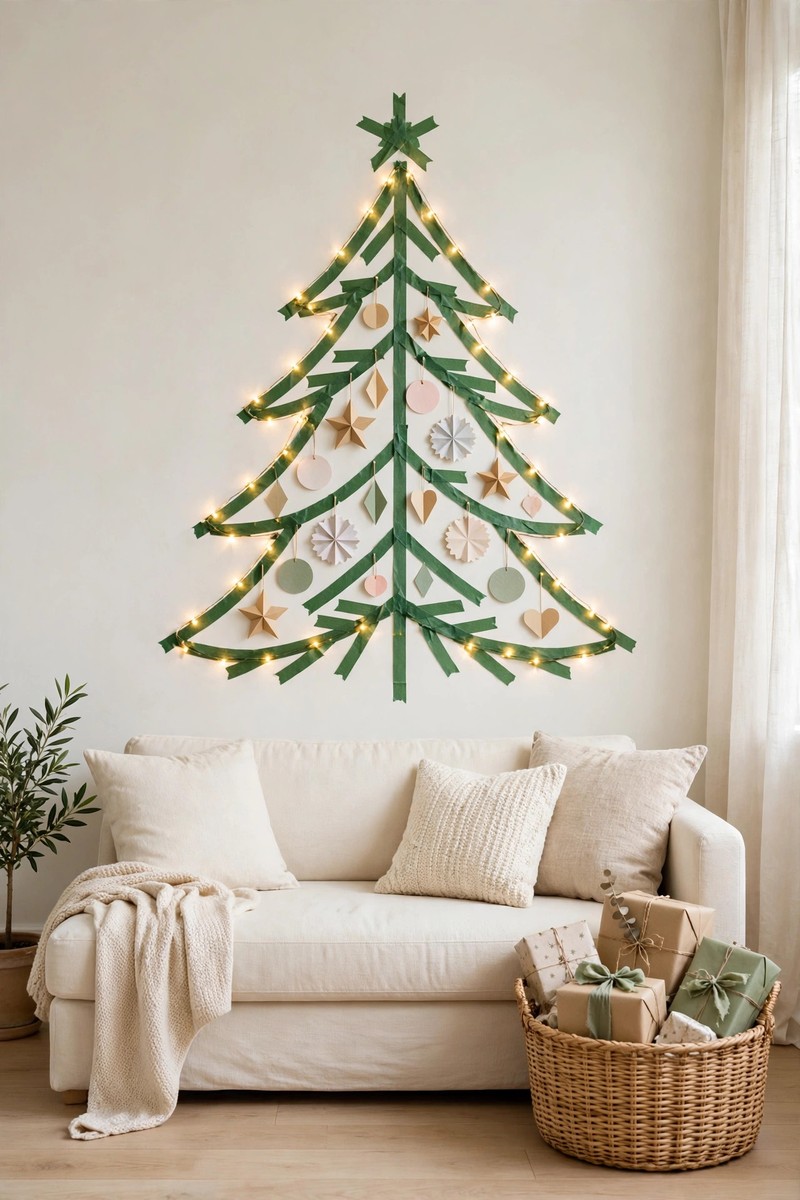
- Green washi tape costs 3 to 6 dollars a roll and peels off without marks.
- A 4-foot taped tree needs about 30 minutes and a pencil outline first.
- Battery fairy lights clipped along the tape add glow with no cord.
- Kids can stick paper ornaments inside the shape, and nothing breaks.
A washi tape tree turns a blank wall into Christmas in about 30 minutes, with zero floor space lost. Sketch a triangle outline in pencil, then lay strips of green washi tape along the lines, working from the top point down to a wide base about 3 feet across. Most rolls cost 3 to 6 dollars, and one roll covers a 4-foot tree with tape to spare. Clip a strand of fairy lights along the tape lines, and the shape glows at night like a real tree. Paper ornaments, photos, or gift tags stuck inside the shape make it personal.
The best part is the takedown, because washi tape peels off clean with no paint damage and no sticky residue. Press the tape firmly when you apply it, and avoid textured walls, since the tape grips smooth paint best. A small basket of wrapped gifts at the base sells the illusion, and a star cut from gold card tops it off. If the shape looks crooked, peel a strip and re-stick it, since washi tape forgives mistakes. This is the tree for renters who want the look and none of the hassle.
Leaning Ladder Tree
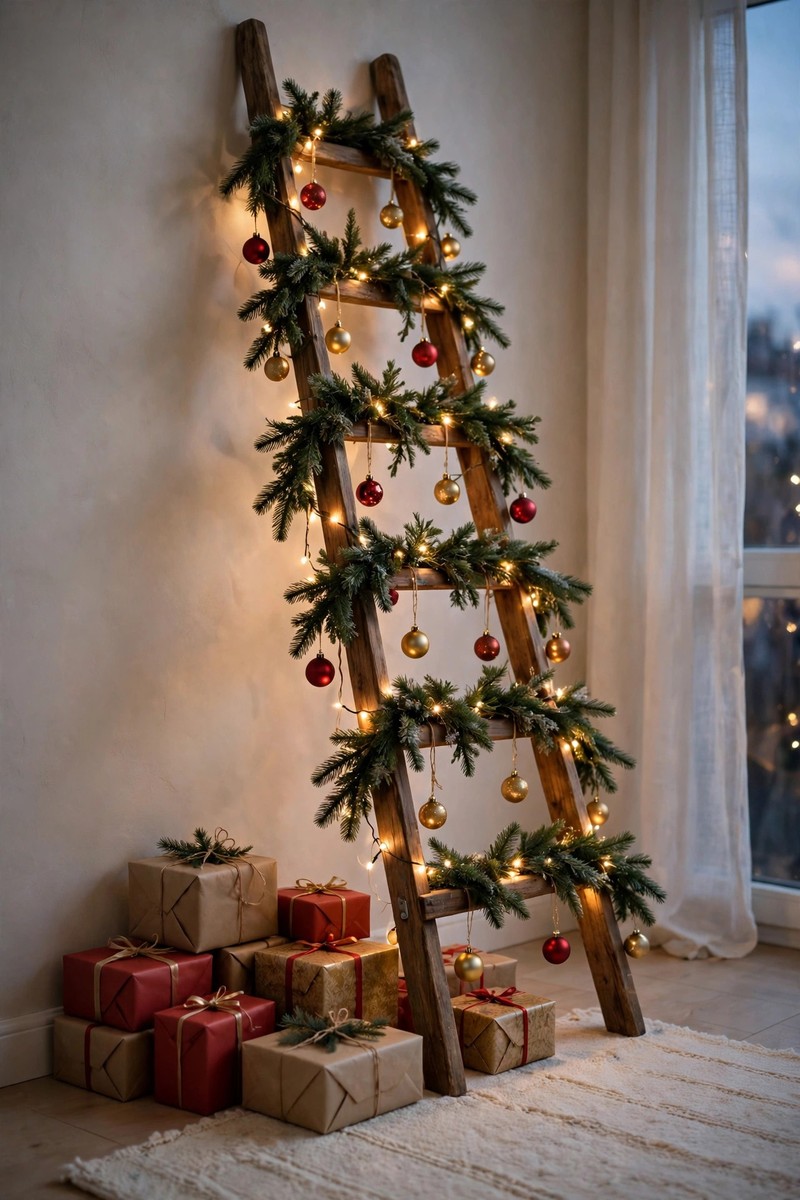
- A 5-foot leaning ladder costs 30 to 60 dollars and doubles as a blanket rack in January.
- Garland wrapped around the rungs gives the ladder a full tree shape.
- Ornaments hang from the rails with ribbon, so nothing needs a hook.
- The ladder leans, so it needs no wall mount and no screws.
A leaning ladder becomes a Christmas tree with a garland, some lights, and about 20 minutes of work. Lean a 5-foot wooden ladder against a blank wall at a slight angle, wrap a 6-foot pine garland around the rungs from top to bottom, and weave a strand of warm white lights through the branches. Hang 12 to 15 ornaments from the rails with short pieces of ribbon, keeping the heaviest ones low so the ladder stays steady. Most ladders cost 30 to 60 dollars, and the garland adds another 15 to 25 dollars.
The ladder tree works in corners where a real tree would block the walkway, and it stores flat against a wall when the season ends. It leans at a gentle angle, so it never tips forward. Anchor the top with a small Command hook if the floor is slick, since a ladder on hardwood can slide. A few wrapped gifts at the base and a star clipped to the top rung finish the look. In January, unwrap the garland, and the ladder goes back to holding blankets and towels. One purchase, two jobs, and no holes in the wall.
Potted Pine Tree
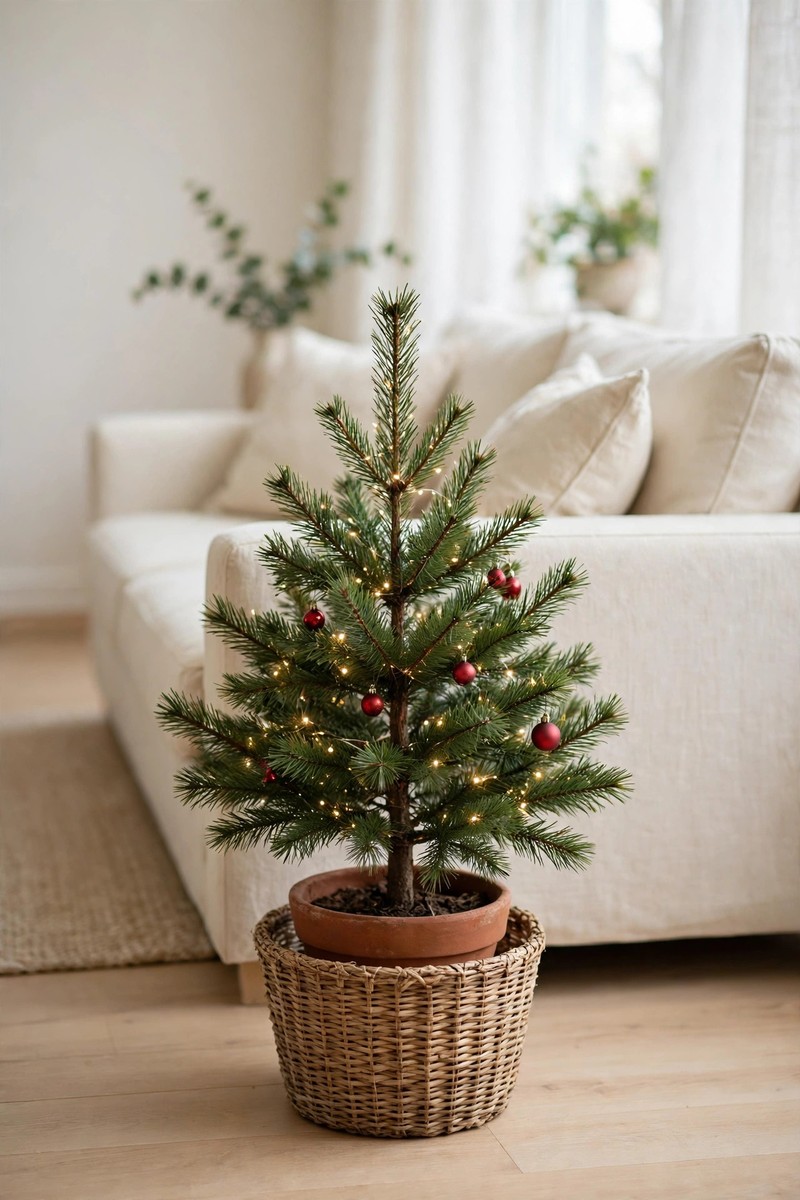
- A live 3-foot potted pine costs 25 to 50 dollars at a garden center.
- It smells like a real tree because it is one, and it needs a drink every 3 days.
- A saucer under the pot protects the floor from water rings.
- After Christmas, the tree moves to a balcony or a friend with a yard.
A potted pine is the closest thing to a real Christmas tree that fits a rental. Buy a 3-foot Norfolk pine or a spruce in a pot, set it in a woven basket with a saucer underneath, and wrap the branches with a short strand of tiny white lights. Most garden centers sell them for 25 to 50 dollars in late November, and the tree needs water every 3 days, about a cup at a time. A few small ornaments, no more than 10, keep the thin branches from bending. The pine scent is real, because the tree is alive.
The potted pine also solves the January problem, since it does not go to the dumpster like a cut tree. Move it to a sunny spot after the holidays, keep watering it once a week, and it becomes a houseplant for the rest of the year. If the branches brown at the tips, the air is too dry, so mist the tree twice a week or set a small bowl of water nearby. A living tree costs about the same as a fake one, and it keeps growing long after the ornaments come off.
Slim Corner Tree
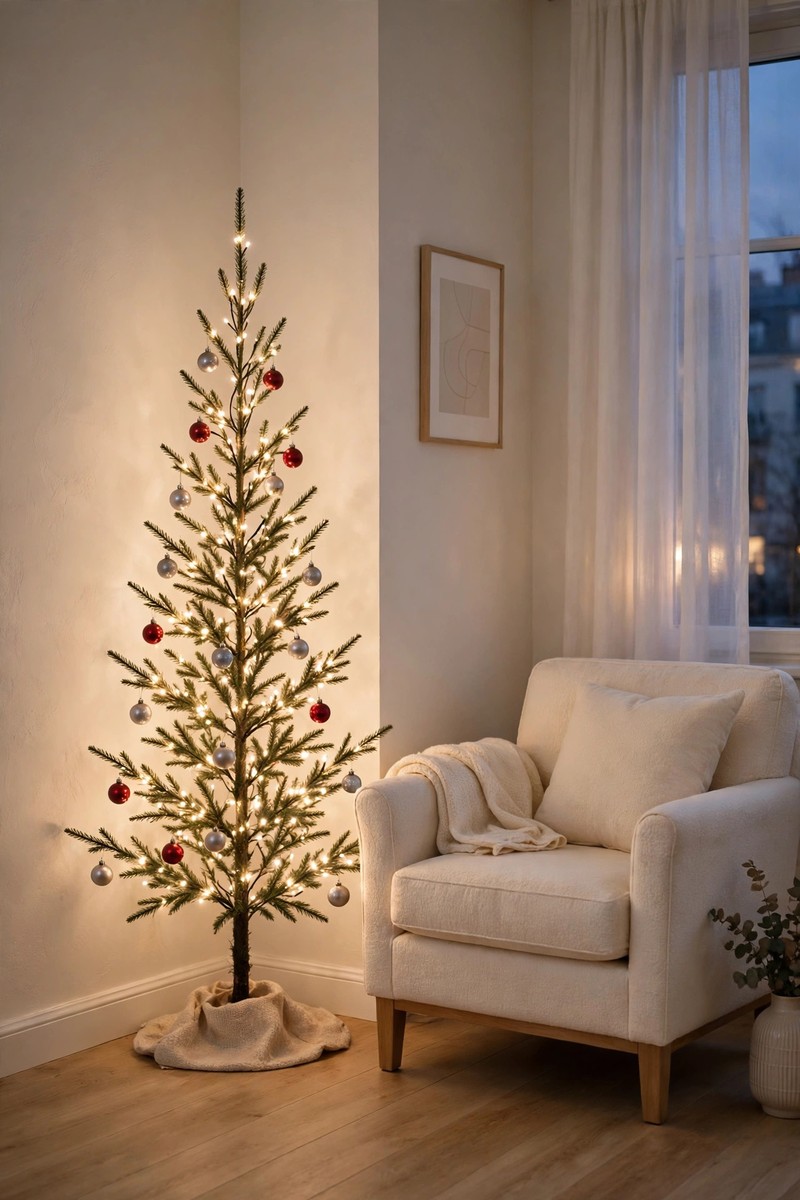
- A pencil tree is only 18 to 24 inches wide, so it fits corners a full tree cannot.
- Pre-lit slim trees cost 60 to 120 dollars and set up in about 15 minutes.
- Hang ornaments on the outer tips only, since the inner branches are short.
- A small tree skirt or a basket base hides the stand in a tight corner.
A pencil tree gives you a full-height Christmas tree in a footprint smaller than a bar stool. These slim trees stand 6 feet tall but measure only 18 to 24 inches across, so they slide into a corner beside the sofa or between the TV stand and the wall. Pre-lit models cost 60 to 120 dollars, set up in about 15 minutes, and need just 30 to 40 ornaments to look full. Hang ornaments on the outer branch tips, since the inner branches are too short to hold them. Warm white lights keep the narrow shape looking soft, not stark.
Corners are wasted space in most small apartments, and a pencil tree turns one into the holiday focal point. Measure the corner before you buy, and leave 3 inches of clearance from each wall so the branches do not rub the paint. A small tree skirt or a woven basket hides the metal stand, and a few gifts at the base finish the scene. At takedown, the tree folds into a box that slides under the bed. Big tree energy, small apartment footprint, and no ladder needed to decorate the top.
Bookshelf Garland Drape
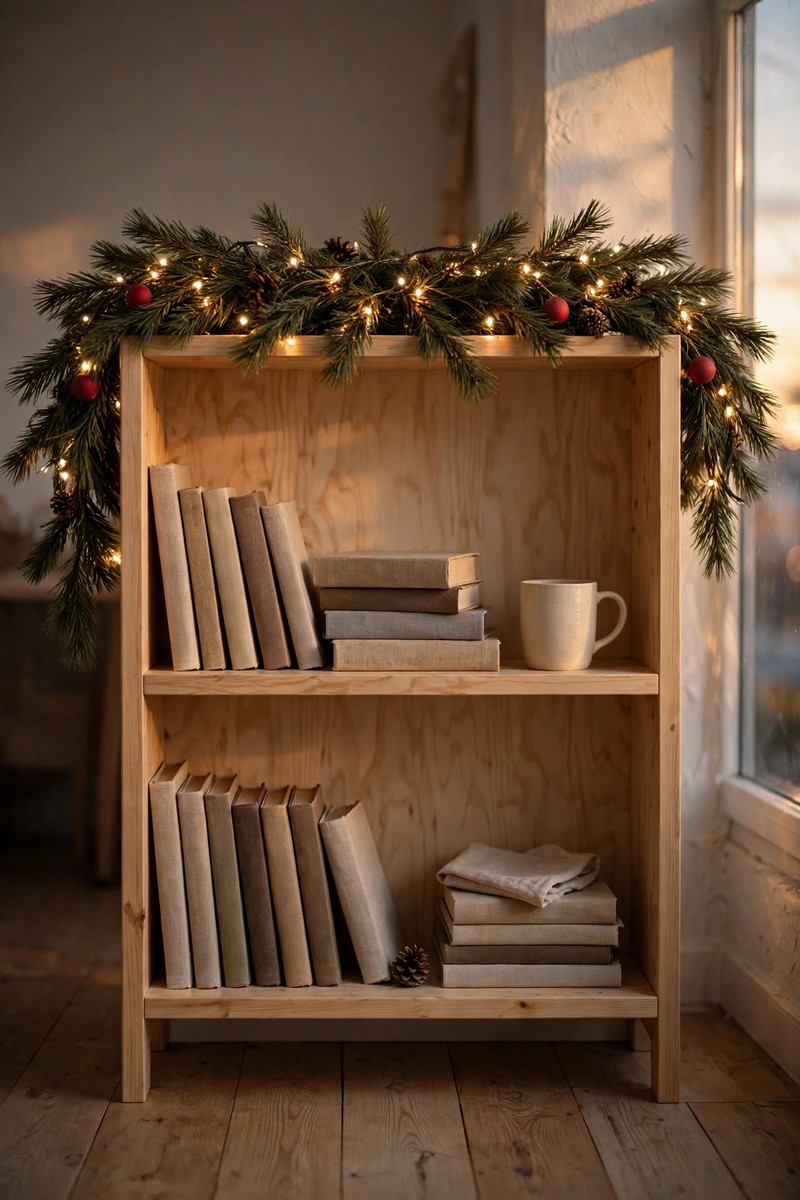
- A 6-foot faux pine garland costs 15 to 30 dollars and lasts for years.
- Drape it across the top shelf, then let the ends hang down 12 inches.
- Weave a battery light strand through the garland so no cord shows.
- Tuck pinecones and ornaments into the branches for a full, layered look.
A bookshelf garland turns the biggest piece of furniture in the room into a Christmas display. Drape a 6-foot faux pine garland across the top shelf, let the ends hang down about 12 inches on each side, and weave a strand of warm white lights through the branches. Most garlands cost 15 to 30 dollars, and one strand is enough for a standard 3-foot-wide shelf. Tuck 5 or 6 pinecones and a few ornaments into the branches, and the shelf looks dressed without a single nail. A garland with mixed pine tips looks more real than a flat, single-color one.
The shelf below the garland is free real estate, so style it with the season in mind. Swap a few book spines for red and green covers, add a small ceramic mug with candy canes, and leave one shelf mostly empty so the garland stays the star. Battery lights matter here, because a cord draped down the shelf looks messy and blocks the books. In January, the garland rolls up into a storage bin in about 2 minutes, and the bookshelf goes back to normal with no marks left behind.
Stocking Hook Rail
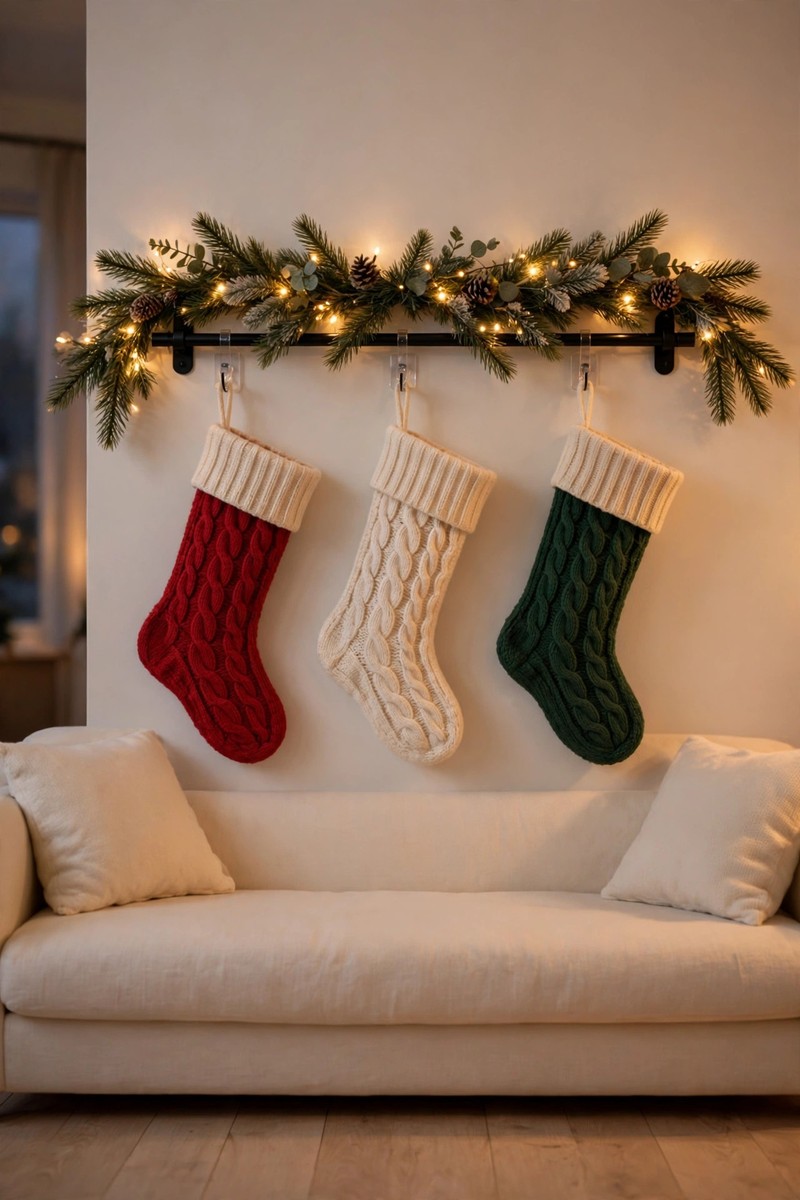
- A 24-inch adhesive rail holds three stockings and costs 15 to 25 dollars.
- Command strips rated for 3 pounds each hold the rail with no drilling.
- Stuff stockings with tissue paper so they keep their shape on the wall.
- Hang the rail at eye level, about 60 inches from the floor.
Stockings need a home even when there is no mantel, and an adhesive rail gives them one. Mount a 24-inch metal rail on a blank wall with two Command strips rated for 3 pounds each, and hang three stockings from S-hooks along the bar. Most rails cost 15 to 25 dollars, and the whole setup takes about 10 minutes. Stuff each stocking with tissue paper so it keeps its shape, and drape a short garland along the top of the rail for a finished look. A battery light strand woven through the garland adds glow without a cord.
Place the rail where people see it when they walk in, like the wall beside the front door or above the sofa. A garland draped along the rail adds color and hides the hooks from view. Keep stockings at least 6 inches apart so they do not tangle, and hang the heaviest gifts low in the stocking so the hooks stay put. At takedown, warm the adhesive strips with a hair dryer for 30 seconds, peel slowly, and the wall comes out clean. Three stockings, one rail, zero holes, and the wall looks untouched in January.
Console Shelf Scene
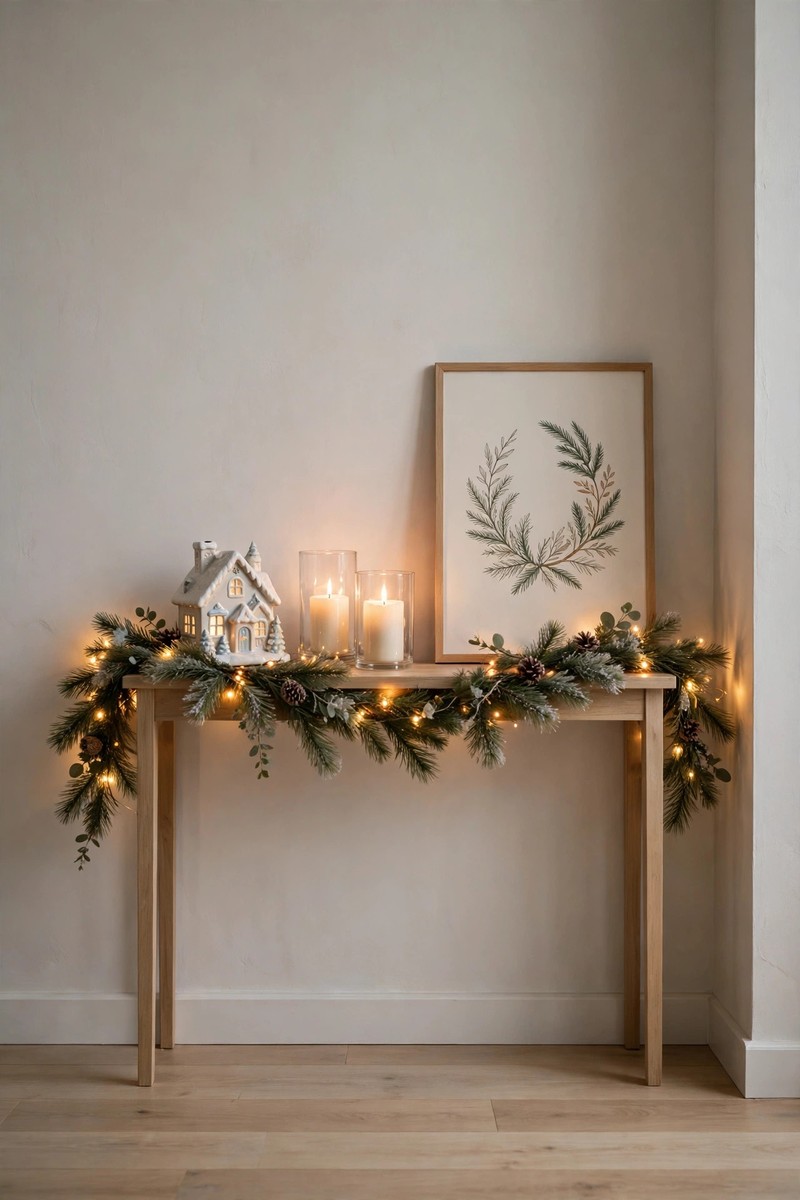
- A console table scene costs 30 to 60 dollars using pieces you already own.
- Layer three heights: a tall print, a mid-size house, and low candles.
- Battery candles glow all evening with no fire risk near the garland.
- Swap one or two pieces each year to keep the scene feeling fresh.
A console table is the stage for a Christmas scene, because it sits at eye level and takes up no floor space. Start with a pine garland along the back edge, lean a framed holiday print against the wall, and add a small ceramic village house in the middle. Two pillar candles in glass holders flank the house, and a strand of fairy lights ties the whole scene together. Most of these pieces cost 30 to 60 dollars total, and half of them are things you already own. Three heights keep the scene interesting: tall print, mid-size house, low candles.
The trick is to stop before the table looks crowded, since a console scene works best with 5 to 7 pieces. Leave a few inches of empty table on each end, so the display breathes and the eye lands on the house first. Battery candles matter near a garland, because a real flame and dry pine do not mix. Change one piece each year, a new print or a different house, and the scene feels fresh without a full rebuild. Guests see it the second they walk in, and it sets the tone for the whole apartment.
Ornament Bowl Display

- A glass bowl display takes 5 minutes and costs under 20 dollars.
- Mix three ornament sizes, 2, 3, and 4 inches, for a layered look.
- A battery light strand inside the bowl makes the ornaments glow.
- Use shatterproof ornaments if the bowl sits where it could tip.
An ornament bowl is the fastest Christmas decor, and it looks far more expensive than it is. Fill a large glass bowl with 20 to 30 ornaments in two or three colors, mixing 2, 3, and 4 inch sizes so the pile looks layered instead of flat. Coil a battery light strand inside the bowl before you add the top layer, and the ornaments glow from within at night. Most bowls cost 10 to 20 dollars, and shatterproof ornaments run about 12 dollars for a box of 24. A pine sprig on top finishes the display.
Set the bowl on a coffee table, a dining table, or an entry console, anywhere guests will see it up close. Keep the color palette tight, red and gold or silver and white, since a rainbow pile looks messy in a small bowl. If the bowl sits near an edge, use shatterproof ornaments only, because one bump sends glass ornaments everywhere. At takedown, pour the ornaments back into their box in about 3 minutes. Five minutes to build, three minutes to pack, and it looks like a magazine photo all month.
Advent Calendar Wall
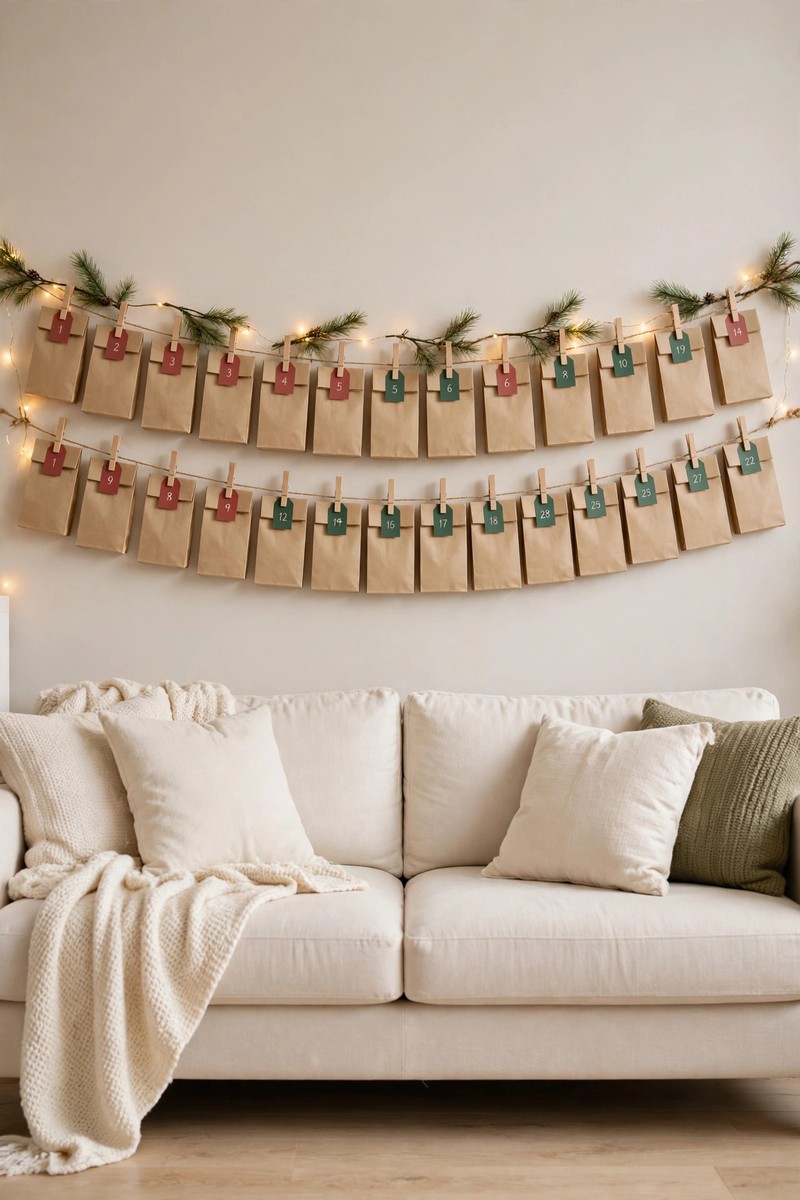
- A 24-bag advent calendar costs 10 to 20 dollars to make from craft supplies.
- Clip the bags to a string with mini clothespins and two Command hooks.
- Fill each bag with a small treat, a note, or a tiny ornament.
- The string spans about 4 feet, so it fits above a sofa or a desk.
An advent calendar wall turns the countdown into decor, and it costs almost nothing to build. String a length of twine between two Command hooks, clip 24 kraft bags along it with mini clothespins, and number each bag with a red or green tag. Most of the supplies cost 10 to 20 dollars at a craft store, and the project takes about an hour. Fill each bag with a small treat, a handwritten note, or a tiny ornament, and open one every morning in December. A pine sprig and a fairy light strand along the twine make the wall glow.
Hang the string about 4 feet wide, above a sofa or a desk where you will see it every day. The wall fills up as December goes on. Keep the bags light, under 2 ounces each, so the Command hooks hold all month without slipping. Kids love pulling a bag down each morning, and adults like the notes even more, since a kind word beats another chocolate. On Christmas Eve, the empty string comes down in minutes, and the bags fold flat into an envelope for next year. One hour of crafting, 24 days of anticipation.
Plaid Table Runner
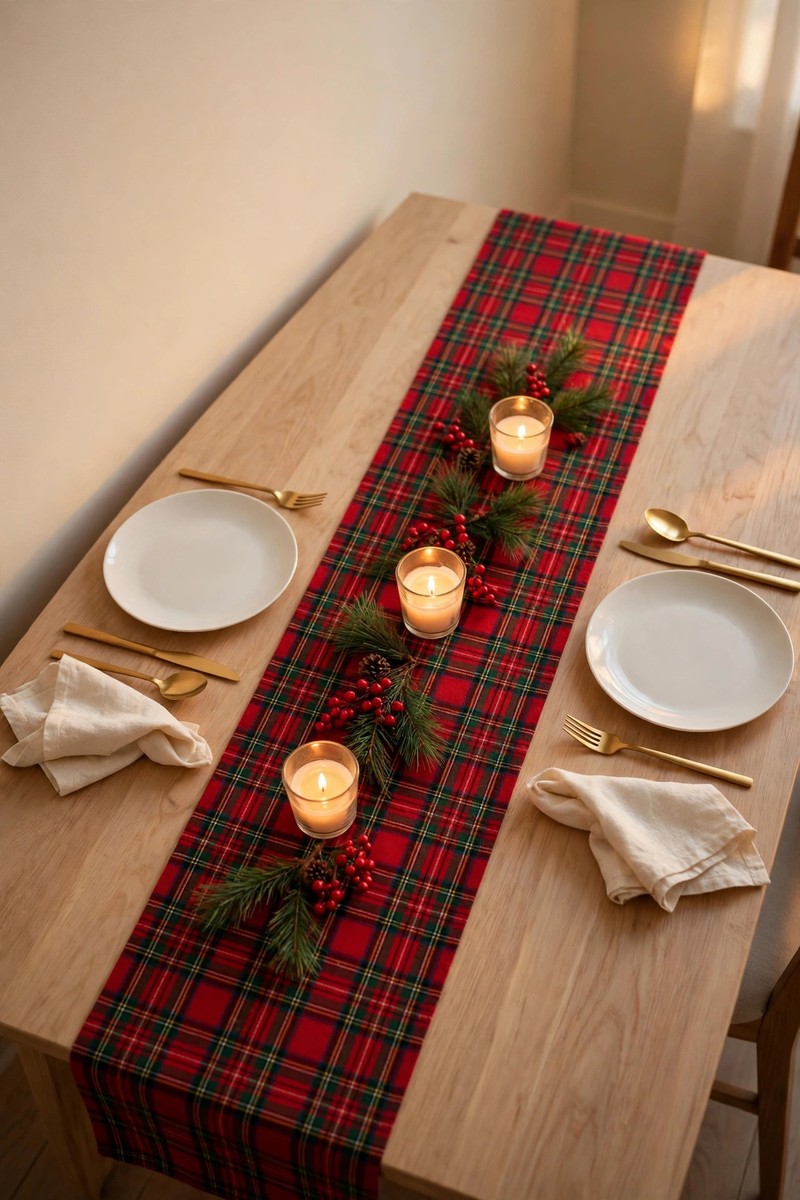
- A plaid runner costs 12 to 25 dollars and instantly says Christmas.
- Pick a runner 12 inches longer than the table so it drapes 6 inches at each end.
- Scatter pine sprigs and red berries along the runner for a natural touch.
- Washable cotton runners survive gravy spills and red wine.
A plaid runner is the fastest way to turn a table into a Christmas table. Lay a red and green plaid runner down the center of the dining table, let it drape 6 inches over each end, and the room shifts into holiday mode. Most runners cost 12 to 25 dollars, and a washable cotton one survives gravy and wine without a fuss. Scatter a few pine sprigs and red berries along the runner, and add white plates with gold cutlery for a warm look. The runner does the heavy lifting, so the rest of the table can stay simple.
Pick a runner about 12 inches longer than the table, so the drape looks intentional instead of short. A buffalo check pattern reads more modern, while a tartan plaid leans traditional, so match it to the rest of your decor. If the table seats four, a 72-inch runner fits most apartment tables. Fold the runner in half for a smaller table, or layer it over a plain white cloth for a fancier dinner. After the holidays, toss it in the wash, fold it flat, and it stores in a drawer until next December.
Pinecone Centerpiece Tray
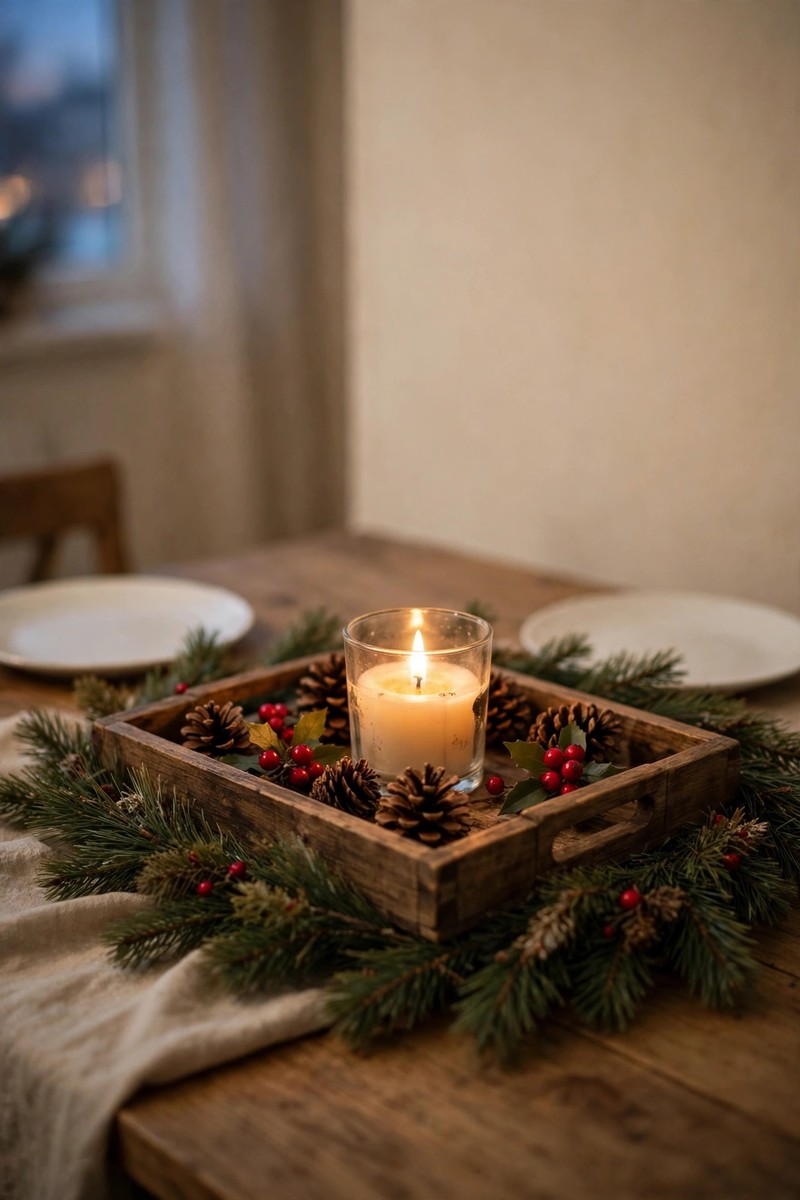
- A tray centerpiece costs 15 to 30 dollars and moves off the table in seconds.
- Pinecones from a park are free, and a quick bake kills any bugs.
- Keep candles in glass holders, at least 3 inches from pinecones.
- A round tray fits a small table better than a long runner.
A tray centerpiece brings the forest to the table without taking over the meal. Set a tray in the middle of the dining table, fill it with pinecones, red berries, and a pillar candle in a glass holder, and ring the tray with a pine garland. Most trays cost 15 to 30 dollars, and pinecones gathered from a park are free, bake them at 200 degrees for 30 minutes to kill any bugs. Keep the candle at least 3 inches from the pinecones, and use a glass holder so the flame never touches branches. The centerpiece builds in 10 minutes.
The tray earns its keep because it moves fast, so clear the table for dinner by lifting one tray instead of a dozen small pieces. A round tray suits a small square table, while a long tray fits a rectangular one. Swap the candle for a small potted poinsettia if you want color without a flame. After the meal, the tray goes back to the center of the table and the room looks festive again in seconds. One tray, one lift, and the table is dressed for the whole season.
Festive Dinner Table
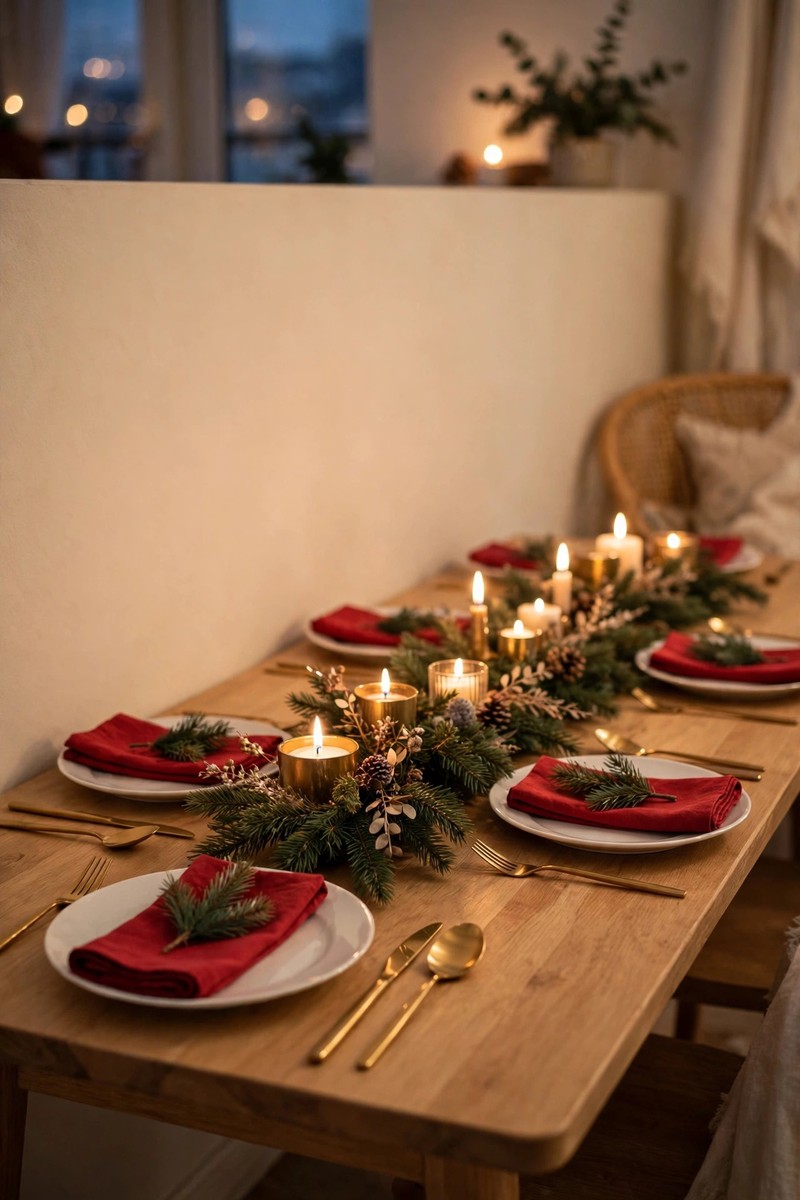
- A full Christmas place setting costs about 8 to 12 dollars per person.
- Red napkins and gold cutlery do most of the work for very little money.
- A pine sprig on each plate doubles as a place card holder.
- Set the table the night before, so Christmas morning stays calm.
A festive dinner table does not need a set, just a few bold swaps that say Christmas. Start with white plates, add red cloth napkins and gold cutlery, and lay a pine sprig across each plate as a place card. A pine garland down the center of the table ties the settings together, and two pillar candles in glass holders add glow without crowding the food. Most pieces cost 8 to 12 dollars per person, and the napkins and cutlery work for every holiday dinner after this one. Set the table the night before, so Christmas morning stays calm.
Keep the centerpiece low, under 10 inches tall, so guests can see each other across the table. A low centerpiece keeps every face visible, which matters most at a holiday meal. A tall vase blocks conversation, while a flat garland invites it. If the table seats six, leave 24 inches of elbow room per person, and pull in a folding chair rather than squeezing an extra seat. Paper name cards tucked into the pine sprigs make guests feel welcome and cost nothing. The table is where Christmas dinner happens, so make it feel like an occasion, not an afterthought.
Hot Cocoa Station

- A cocoa station costs 20 to 35 dollars and uses one tray on the counter.
- Keep cocoa, marshmallows, and candy canes in clear jars so guests help themselves.
- A small tray keeps the station to one corner of the counter.
- Add a mini chalkboard sign with the cocoa recipe for a fun touch.
A hot cocoa station turns a kitchen corner into the warmest spot in the apartment. Set a wooden tray on the counter, add glass jars of cocoa powder and marshmallows, a mug of candy canes, and a small string of warm lights along the backsplash. Most stations cost 20 to 35 dollars, and the tray keeps everything contained in one corner of the counter. A red kettle beside the tray completes the scene, and a mini chalkboard with the cocoa recipe adds a playful touch. Guests help themselves, and the kitchen smells like chocolate all December.
The station works because it is useful, not just pretty, so keep it stocked through the holidays. A full jar looks inviting, so top it up before guests arrive. Refill the marshmallow jar weekly, and swap the candy canes for cinnamon sticks if you want a change. A battery light strand avoids a cord near the kettle, which matters on a small counter. In January, the jars go back in the pantry, the tray returns to the shelf, and the counter is clear in about 5 minutes. One tray, one corner, and every cold evening gets a little warmer.
Cookie Tray Display
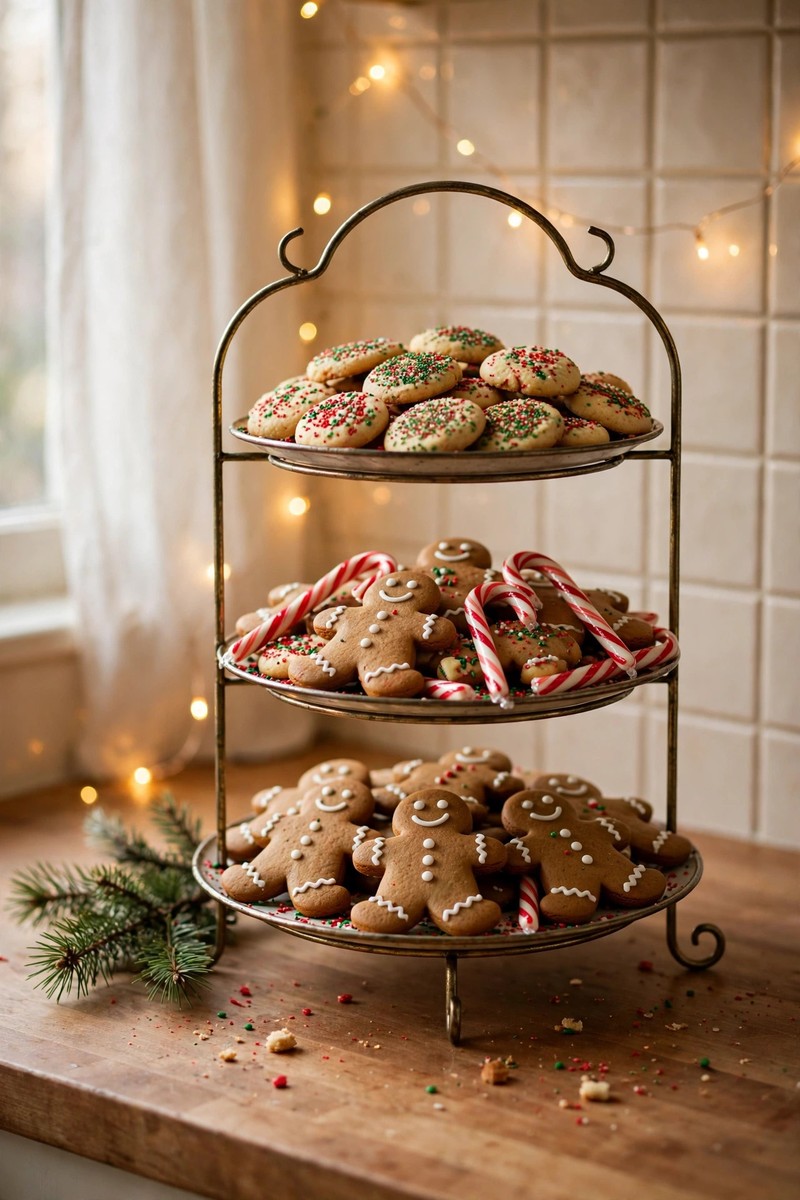
- A tiered stand costs 15 to 30 dollars and holds three layers of cookies.
- Bake or buy 2 dozen cookies, and the stand looks full all week.
- A glass dome keeps cookies fresh and stops the cat from helping.
- Swap in a new batch every 3 days so the display stays fresh.
A cookie tray display makes the kitchen smell like Christmas and look like a bakery. Stack a tiered serving stand with 2 dozen cookies, gingerbread men, sugar cookies with red and green sprinkles, and a few candy canes tucked between the layers. Most stands cost 15 to 30 dollars, and a glass dome on top keeps the cookies fresh for 3 days. A pine sprig beside the stand and a short fairy light strand along the backsplash finish the scene. Bake the cookies yourself, or buy a bakery box for about 12 dollars and arrange them on the stand.
The stand earns its spot because it is edible decor, so guests graze all evening and the display never feels like clutter. Keep the cookies in three layers, tallest on the bottom, smallest on top, so the stand looks full from every angle. A glass dome matters if you have a cat, because cats love an open cookie tray. Refill the stand every 3 days, and rotate the flavors, peppermint one week, gingerbread the next. The kitchen becomes the room everyone drifts toward, which is exactly where you want them.
Front Door Wreath
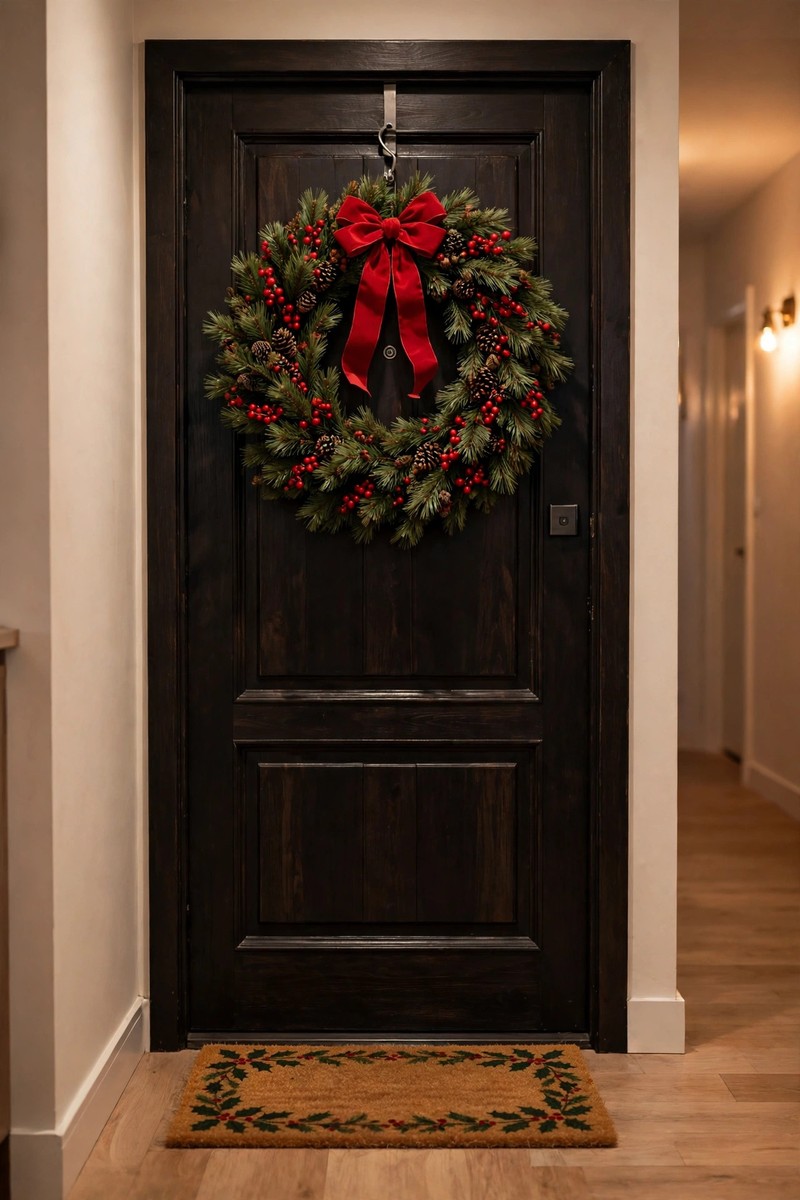
- A full 24-inch wreath costs 25 to 50 dollars and fits most apartment doors.
- An over-door hook holds it with no nails, no screws, and no damage.
- A battery light strand woven through the wreath glows after dark.
- A wreath with berries and pinecones looks fuller than plain pine.
A wreath on the front door is the first Christmas hello your home gives, and it takes 2 minutes to hang. Pick a 24-inch pine wreath with red berries and a red bow, slip an over-door hook over the top of the door, and hang the wreath from it. Most wreaths cost 25 to 50 dollars, and the hook adds 5 dollars. No nails, no screws, and no landlord phone call. A light strand woven through the branches makes the wreath glow after dark. Choose a wreath with berries and pinecones, since plain pine looks thin from the hallway.
Measure the door before you buy, since some apartment doors are narrow and a 24-inch wreath can overwhelm them. A 20-inch wreath suits a standard 36-inch door, and a 24-inch wreath fits a wider entry. A fuller wreath reads better from down the hall than a thin one. Hang the wreath at eye level, about 60 inches from the floor, so it reads from down the hall. In January, the wreath comes off in seconds, and the hook slides off the door with no marks. Two minutes to hang, two minutes to remove, and the whole hallway feels like Christmas.
Doorframe Garland Wrap
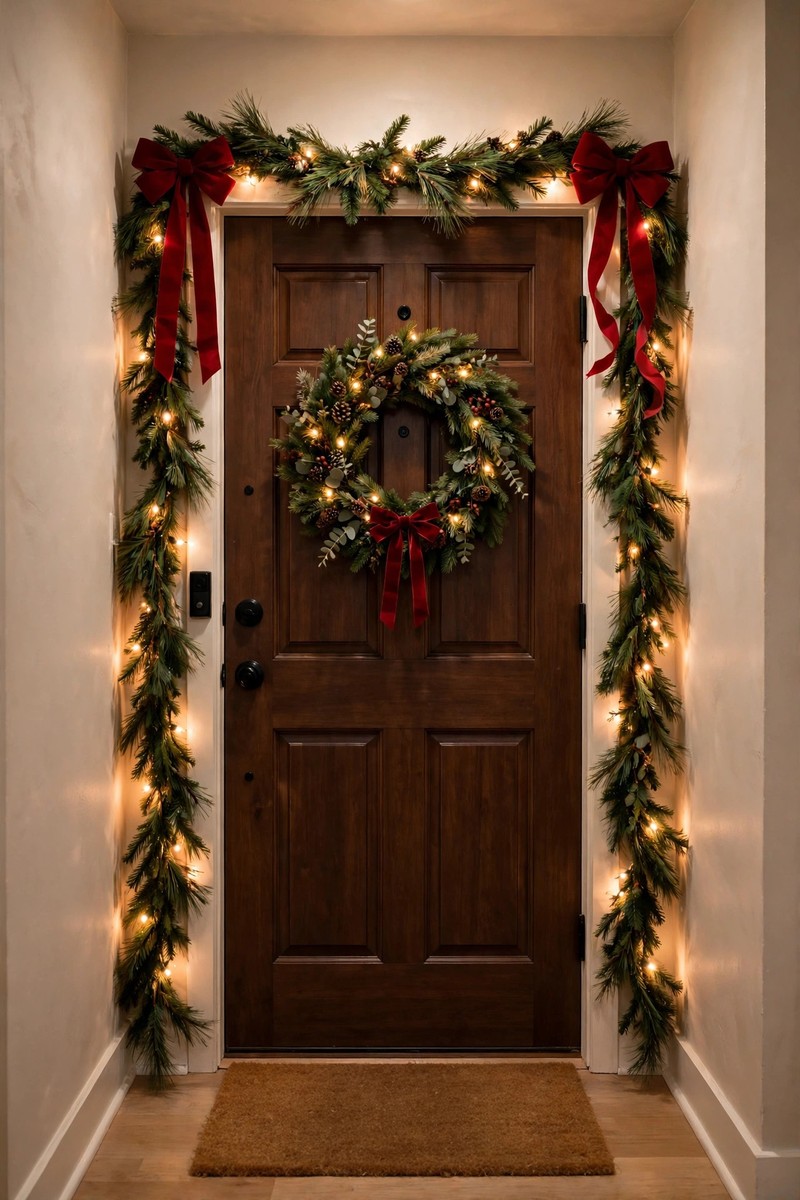
- A 9-foot garland wraps a standard door frame with enough left for a swag.
- Command hooks every 12 inches hold the garland with no nails.
- Red ribbon bows at the top corners hide the hooks and add color.
- A pre-lit garland saves 20 minutes of light weaving.
A garland around the door frame turns the entrance into a Christmas arch, and it takes 20 minutes to hang. Drape a 9-foot pine garland over the top of the door frame, let the ends hang down both sides, and secure it with Command hooks every 12 inches. Most garlands cost 20 to 40 dollars, and a pre-lit one saves 20 minutes of light weaving. Tie red ribbon bows at the top corners to hide the hooks and add a pop of color. The garland frames the wreath on the door, so the whole entrance reads as one big display.
Space the hooks evenly, and press each Command strip firmly for 30 seconds so the garland stays put all month. A garland with mixed pine tips and a few red berries looks fuller than a flat one, and a battery light strand adds glow without a cord in the hallway. If the garland sags in the middle, add one more hook at the center of the top frame. At takedown, warm the strips with a hair dryer, peel slowly, and the frame comes out clean. Twenty minutes up, ten minutes down, and the entrance looks like a holiday card.
Holiday Doormat Swap
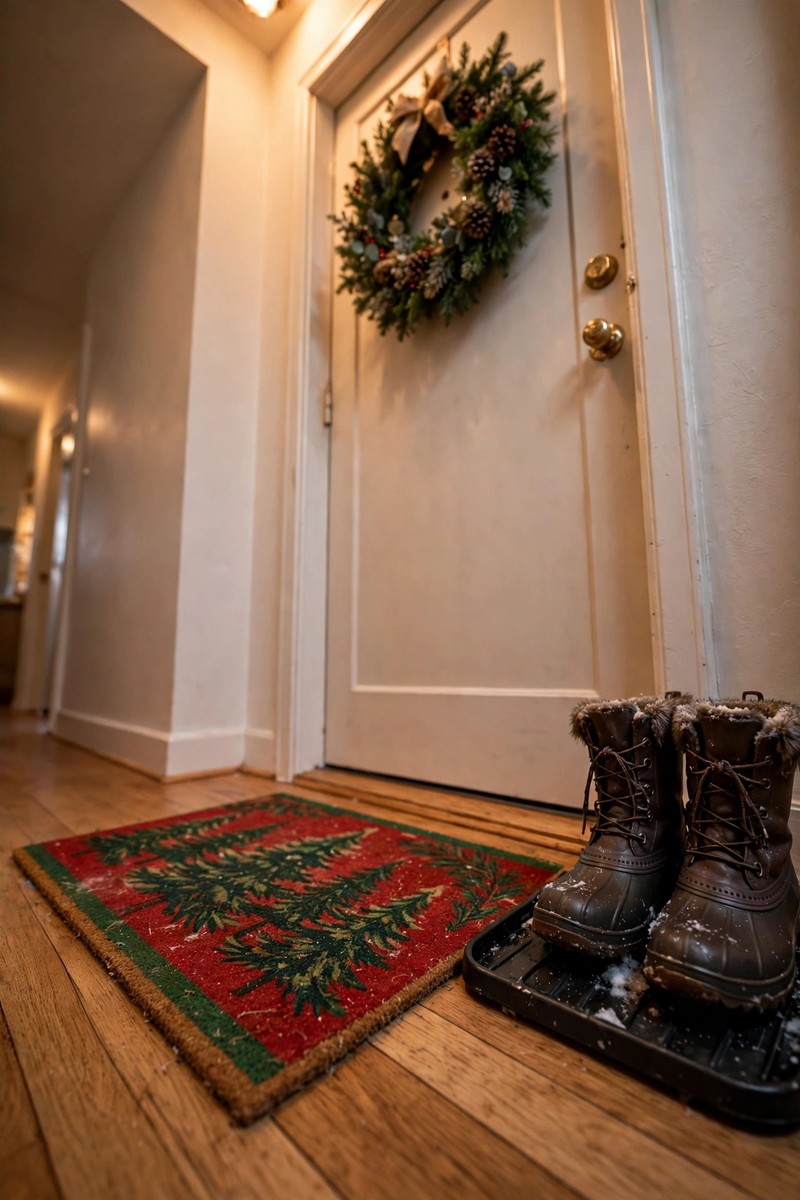
- A holiday doormat costs 15 to 30 dollars and swaps in under a minute.
- Coir mats scrape slush off boots and hide salt stains.
- Layer it over a plain mat for a bigger, styled look.
- A 24 by 36 inch mat fits most apartment entries.
A holiday doormat is the cheapest Christmas upgrade, and it takes under a minute. Swap the plain mat for a red and green coir mat with a pine tree or a snowflake pattern, and the whole entry shifts into the season. Most mats cost 15 to 30 dollars, and a 24 by 36 inch size fits most apartment doors. Coir bristles scrape slush and salt off boots, which protects the floor inside, and a dark pattern hides salt stains between cleanings. Layer the holiday mat over a plain black mat for a bigger, styled look that fills the entry.
The doormat works hardest in December, when wet boots track in slush every day. Shake the mat out once a week, and hose it down in the tub if the salt builds up. A mat with a rubber backing stays flat on tile and hardwood, so it never bunches underfoot. In January, swap the holiday mat for the plain one, roll the festive mat up, and store it behind a shelf until next year. One minute to swap, one minute to store, and the entry greets every guest with Christmas.
Command Hook Ornaments
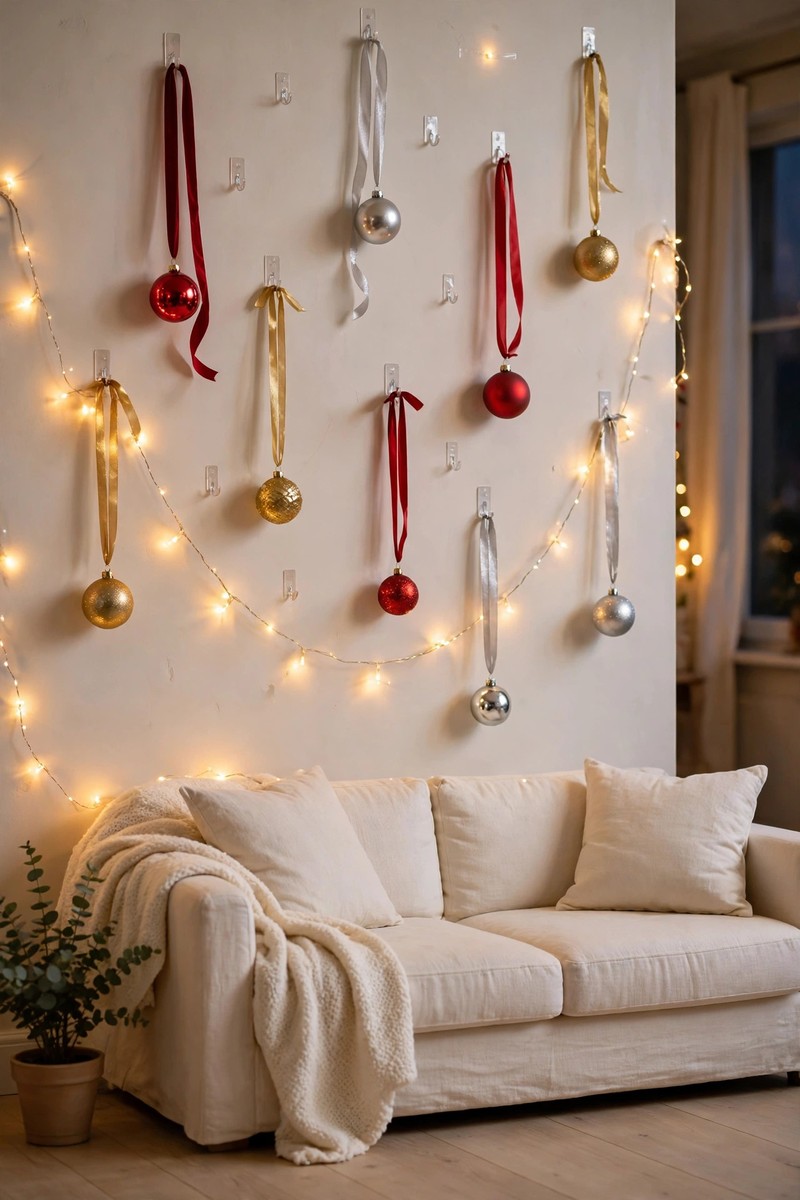
- A wall of hanging ornaments costs 15 to 25 dollars and takes 20 minutes.
- Small Command hooks hold 1 pound each, which covers most ornaments.
- Hang ornaments at three different heights for a floating effect.
- Ribbon lengths of 6, 9, and 12 inches create the staggered look.
Ornaments do not need a tree, and a wall of hanging ornaments proves it. Stick 8 to 10 Command hooks along a blank wall, tie a ribbon to each ornament, and hang them at three heights so they float. Most hooks cost 5 dollars for a pack of 6, and a box of shatterproof ornaments runs 12 dollars. Ribbon lengths of 6, 9, and 12 inches create the staggered look, and a mix of red, gold, and silver keeps the wall festive without feeling random. A fairy light strand along the top of the wall adds glow behind the ornaments.
The wall works best above a sofa or a console table, where the ornaments catch the light and draw the eye. Keep each ornament under 1 pound, since small Command hooks hold 1 pound each, and press each strip firmly for 30 seconds. Space the hooks about 8 inches apart so the ornaments do not knock together. At takedown, warm each strip with a hair dryer, peel slowly, and the wall comes out clean. Twenty minutes to hang, ten minutes to remove, and the wall looks like a Christmas art installation.
Christmas Card Clothesline
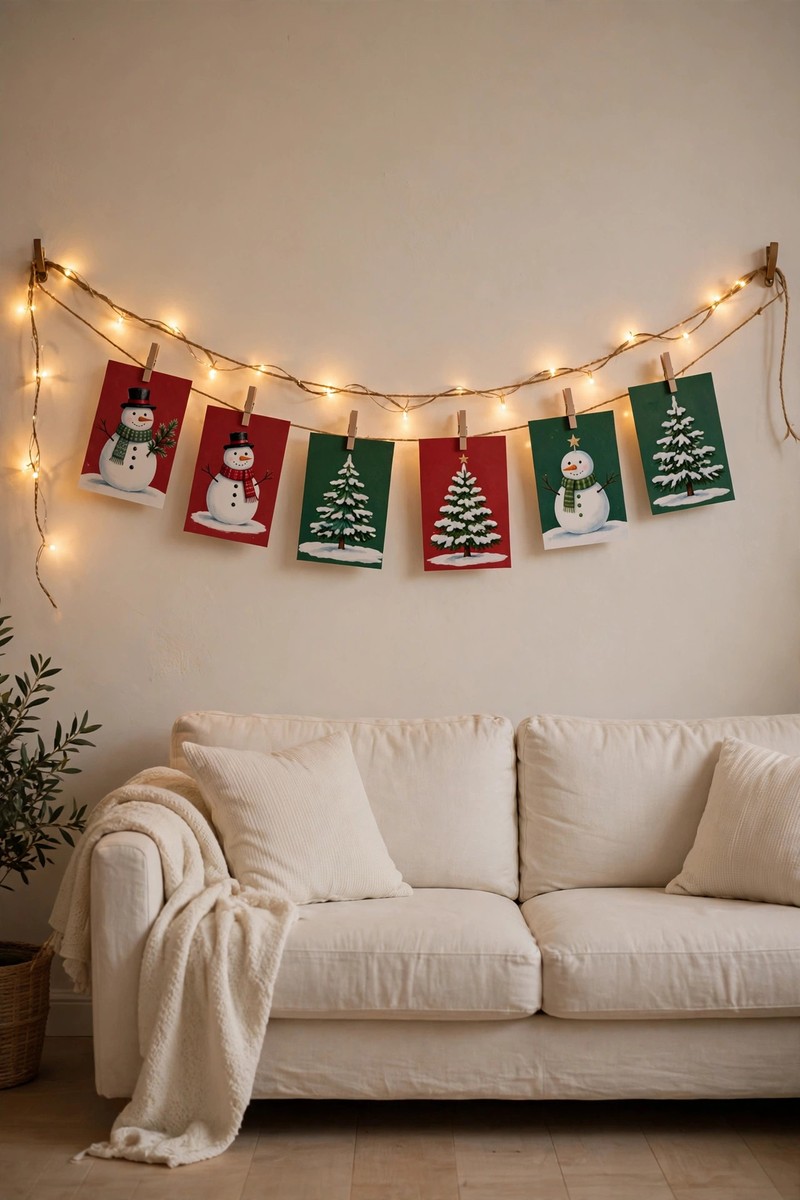
- A card clothesline costs under 10 dollars and grows as cards arrive.
- Two Command hooks and a length of twine are all you need.
- Mini clothespins cost 3 dollars for a pack of 50.
- Hang the line at eye level, about 60 inches from the floor.
A card clothesline turns the holiday mail into a piece of decor. String a length of twine between two Command hooks on a blank wall, and clip each Christmas card to the line with a clothespin as it arrives. Most supplies cost under 10 dollars, and the line grows all December as more cards come in. A fairy light strand along the twine makes the cards glow at night, and a mix of red, green, and gold cards looks festive without planning. Hang the line at eye level, 60 inches from the floor, so every card is easy to read.
The clothesline works because it solves the card problem, since most cards end up in a pile on the counter. Clip each card the day it arrives, and the wall fills up naturally by Christmas week. Keep the line about 4 feet wide, and add a second line below the first if the cards keep coming. In January, unclip the cards, fold the twine into a drawer, and the hooks peel off clean. Ten dollars of supplies, a wall full of holiday cheer, and no card ever gets lost in a pile.
Holiday Print Gallery
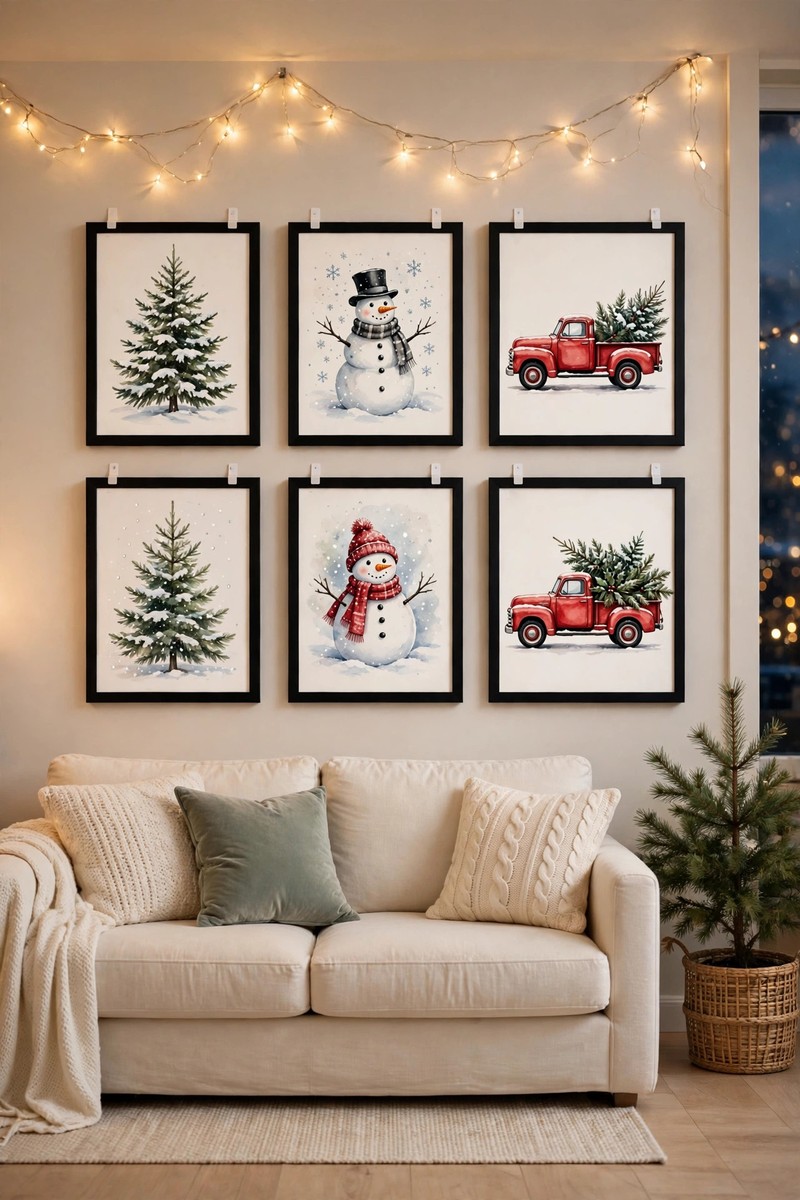
- A four-print gallery costs 25 to 50 dollars using printable art and thrift frames.
- Command picture strips hold frames up to 3 pounds with no nails.
- Mix print sizes, two 8 by 10 inch and two 5 by 7 inch, for a gallery look.
- Swap the prints in January for year-round art in the same frames.
A holiday print gallery brings Christmas to a blank wall with no drilling and no damage. Print four Christmas designs, pine trees, snowmen, a red truck, or a holiday quote, and frame them in thrift store frames. Hang the frames with Command picture strips, which hold up to 3 pounds each, and arrange them in a grid above the sofa. Printables cost 5 to 10 dollars for a set, and thrift frames run 3 to 5 dollars each. Mix two 8 by 10 inch prints with two 5 by 7 inch prints, so the gallery looks collected instead of matched.
The gallery works because it is fast and flexible, so you can hang it in just 20 minutes and change it next year. Space the frames about 2 inches apart, and step back after each one to check the balance. A string of fairy lights along the top of the gallery adds warmth at night. In January, swap the Christmas prints for year-round art in the same frames, and the wall stays dressed all year. Four prints, four frames, and a wall that feels like Christmas without a single nail.
Snowflake Wall Cluster
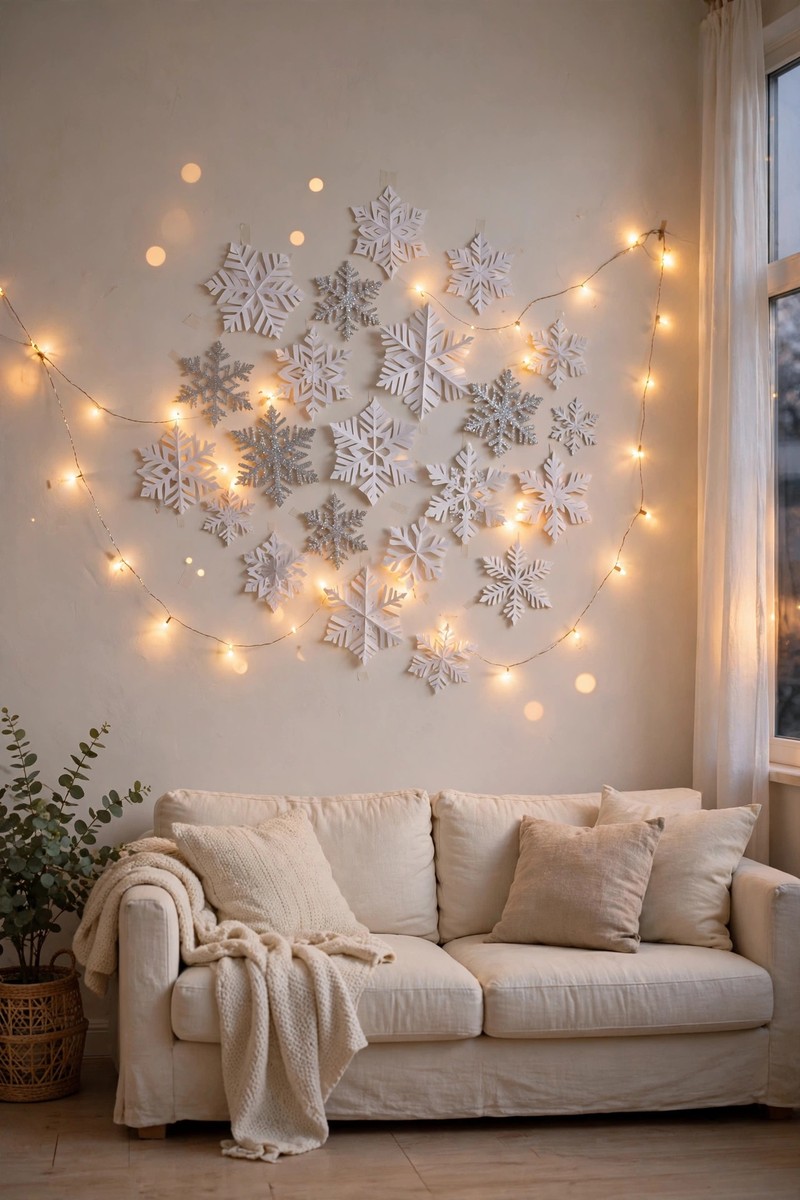
- Paper snowflakes cost under 5 dollars to make from white printer paper.
- Painter tape holds them with no paint damage and no residue.
- Mix three sizes, 4, 6, and 8 inches, for a natural falling look.
- A cluster of 15 to 20 snowflakes fills a wall above a sofa.
Paper snowflakes turn a plain wall into a winter scene for less than 5 dollars. Fold white printer paper into triangles, cut shapes along the edges, and unfold 15 to 20 snowflakes in three sizes, 4, 6, and 8 inches. Stick them to the wall in a cluster with loops of painter tape, which peels off clean with no paint damage. Mix in a few silver glitter snowflakes for sparkle, and run a fairy light strand along the wall behind them. The project takes an hour, and kids love cutting the snowflakes. For window ideas, see the Christmas window guide.
The cluster looks best above a sofa or a bed, where the white shapes pop against a pale wall. Start with the biggest snowflakes in the center, then fill outward with smaller ones, leaving 3 to 4 inches between each. A loose, uneven cluster looks like falling snow, while a perfect grid looks like a classroom. At takedown, peel the tape loops off slowly, and the snowflakes fold flat into a folder for next year. Five dollars, one hour, and a wall that feels like a snowstorm in the best way.
Plaid Bedding Swap
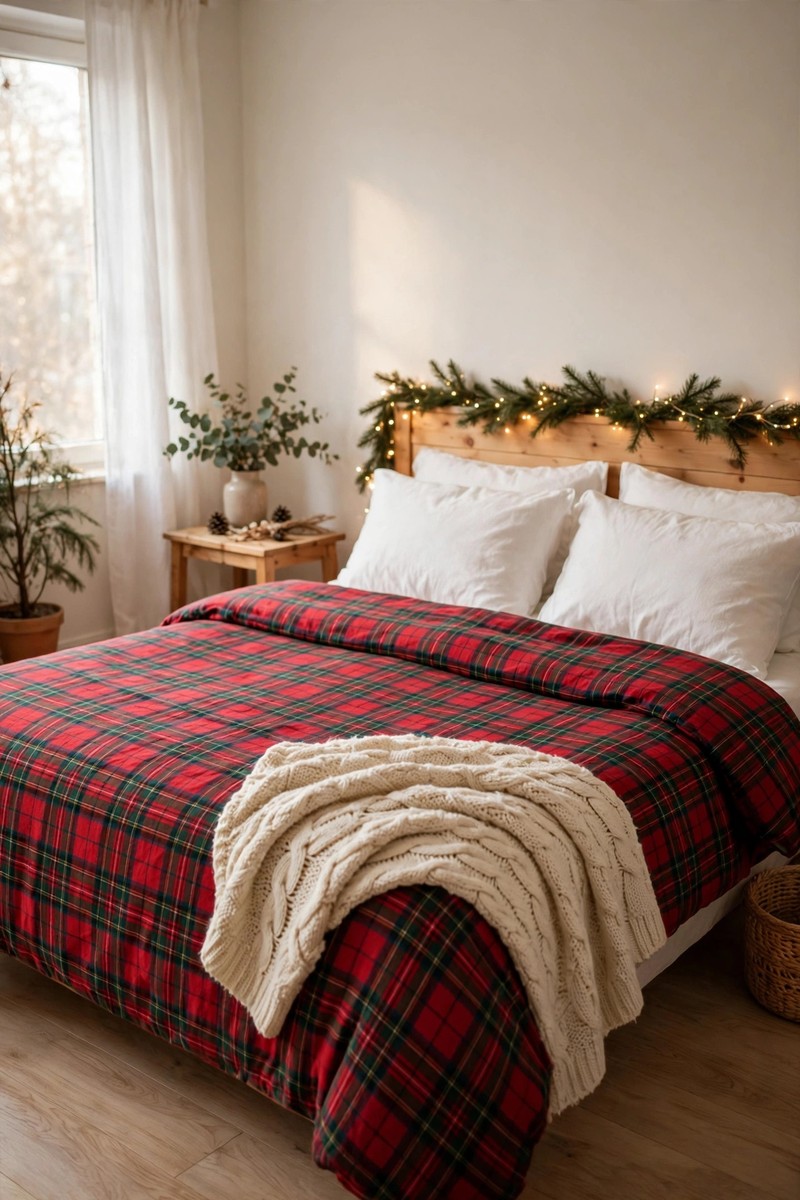
- A plaid duvet set costs 30 to 60 dollars and changes the whole bedroom.
- Red and green plaid reads Christmas, while red and black reads cabin.
- Add a knit throw at the foot of the bed for texture and warmth.
- Wash the set before the holidays so it smells fresh on the first night.
A plaid bedding swap turns the bedroom into a Christmas cabin in 10 minutes. Change the duvet cover to a red and green plaid set, add white pillows and a knit throw at the foot of the bed, and the room shifts into the season. Most plaid duvet sets cost 30 to 60 dollars for a queen size, and a washable cotton set survives the month. Red and green plaid reads Christmas, so pick the set that matches the rest of your decor. A pine garland along the headboard ties the bed to the rest of the room.
The bedding swap works because the bed is the biggest surface in the bedroom, so changing it changes everything. Wash the set before the holidays, so it smells fresh on the first night, and keep a second set of white sheets underneath for easy laundry swaps. A knit throw at the foot of the bed adds texture and warmth for cold December nights. In January, the plaid set goes back in the closet, and the bedroom returns to normal in one laundry load. Ten minutes to swap, one wash to store, and the bedroom feels like a holiday retreat.
Headboard String Lights
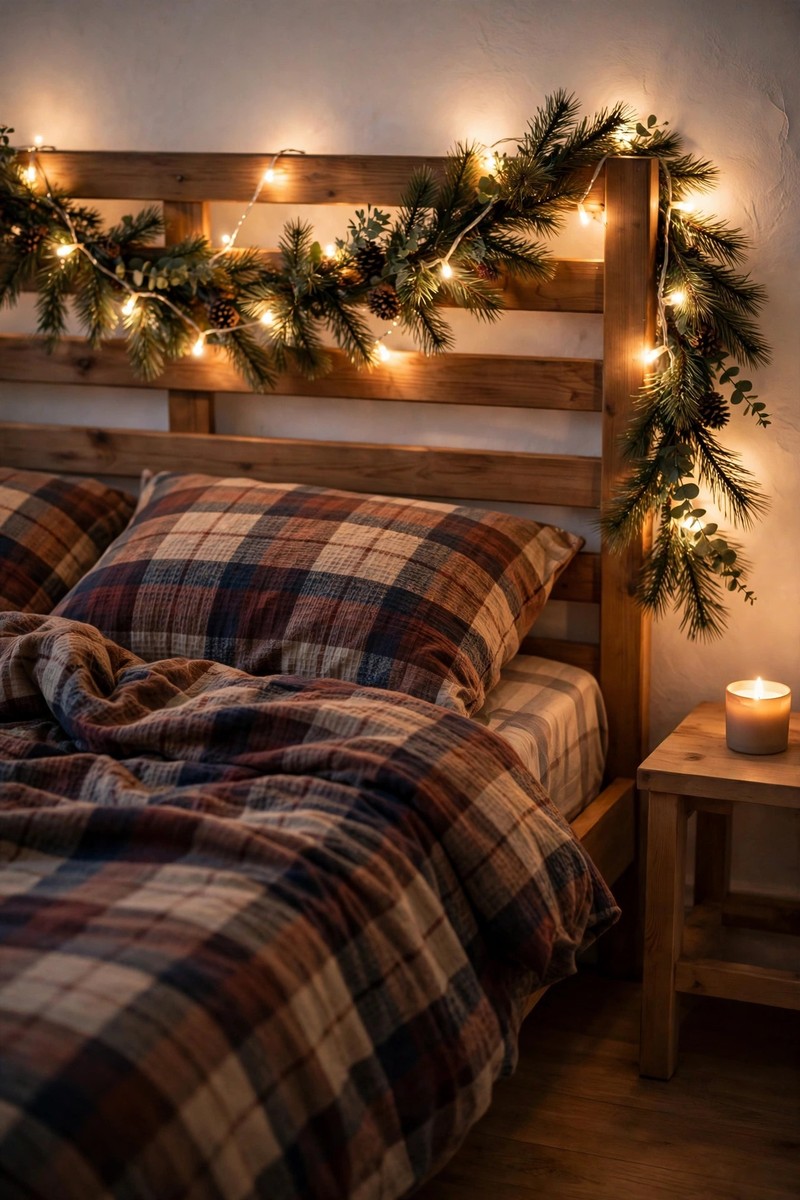
- A 10-foot string light strand costs 8 to 15 dollars and wraps a queen headboard.
- Battery lights avoid a cord across the pillow, which is safer at night.
- Weave a short pine garland through the lights for a fuller look.
- A timer setting turns the lights off after 6 hours, so they never stay on all night.
String lights along the headboard turn the bedroom into a glowing retreat every night in December. Drape a 10-foot strand of warm white lights along the top of the headboard, weave a short pine garland through the strand, and let the ends hang down both sides. Most strands cost 8 to 15 dollars, and battery lights avoid a cord across the pillow, which is safer at night. A timer setting turns the lights off after 6 hours, so they never stay on all night. The glow replaces the bedside lamp for reading, and the room feels like a holiday cabin.
Secure the lights with small Command clips every 12 inches, so the strand stays put without tape or nails. Keep the battery pack behind the headboard or on the bedside table, where it is easy to reach for the timer switch. A pine garland adds fullness, but keep it light, since a heavy garland pulls the lights down. In January, coil the lights neatly around a piece of cardboard, and the garland rolls into a storage bin. Fifteen minutes to hang, five minutes to pack, and every December night glows.
Festive Throw Pillows
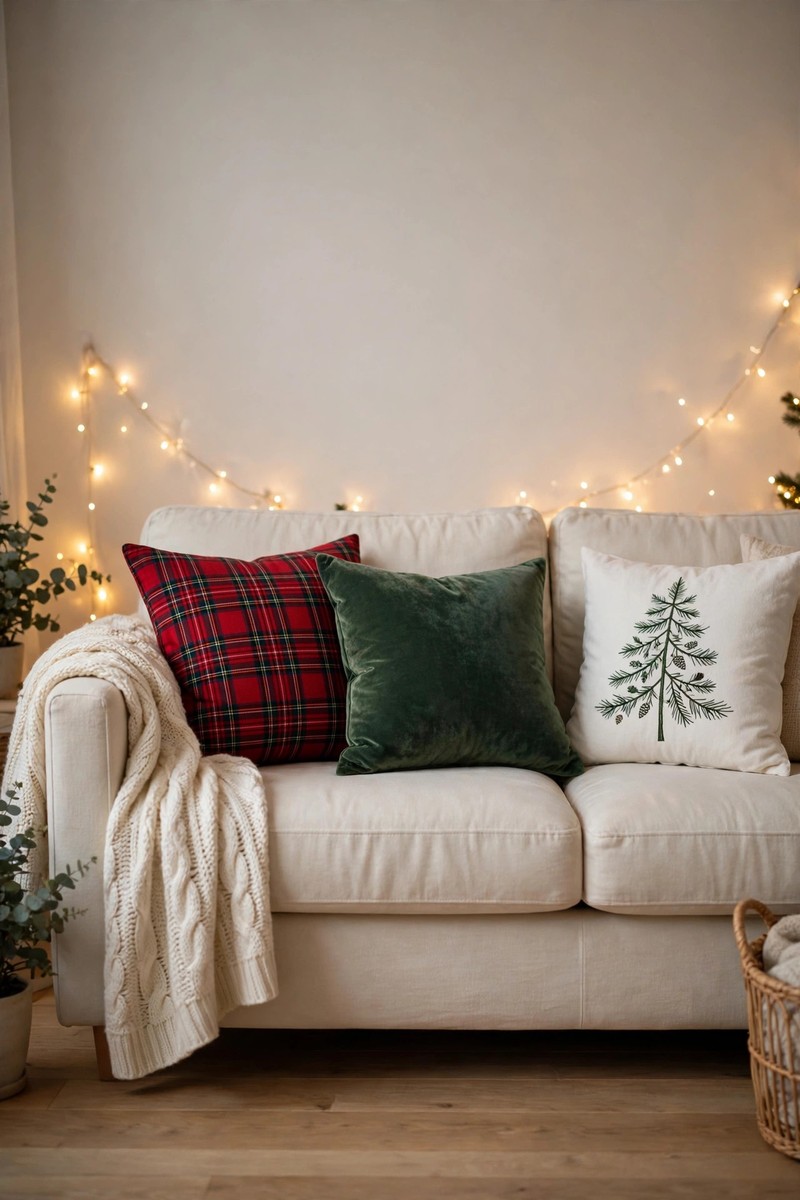
- Throw pillow covers cost 8 to 15 dollars each and swap in seconds.
- Three pillows, one plaid, one velvet, one graphic, make a full set.
- Covers store flat in a drawer, so they take up no closet space.
- Wash the covers in January, and they are ready for next year.
Festive throw pillows are the easiest Christmas swap in the whole apartment, because they take about 2 minutes. Slip red plaid, green velvet, and white pine tree covers over the sofa pillows you already own, and the living room shifts into the season. Most covers cost 8 to 15 dollars each, and three pillows make a full set for a standard sofa. Mix textures, plaid cotton, soft velvet, and a graphic print, so the sofa looks layered instead of flat. A knit throw draped over the arm ties the pillows together and adds warmth for cold nights.
Pillow covers beat whole pillows for renters, because covers store flat in a drawer and take up no closet space. A set of three covers costs less than one new pillow, so the swap stays cheap. Buy covers in standard sizes, 18 by 18 inches for most sofas, and check the zipper before you buy, since a weak zipper splits after one wash. Wash the covers in January, fold them flat, and they are ready for next December. Two minutes to swap, one wash to store, and the sofa looks like Christmas all month.
Holiday Mug Shelf
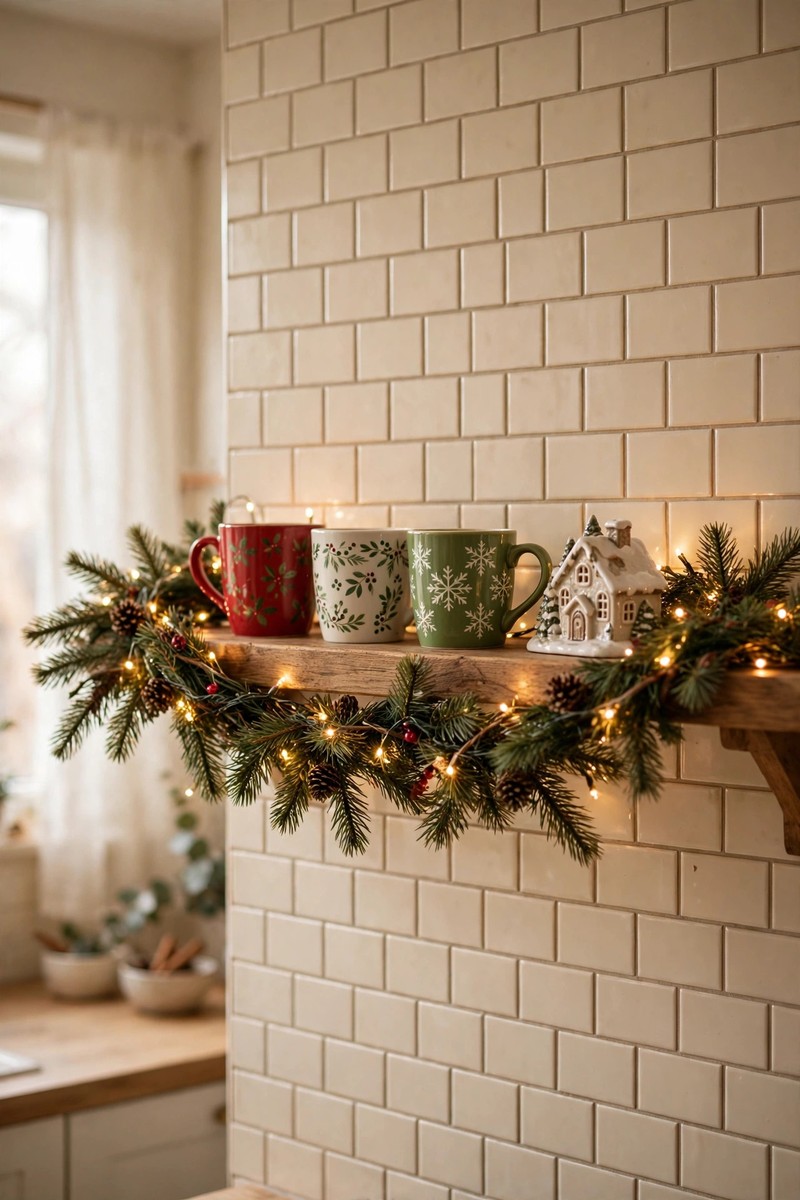
- A holiday mug shelf costs 15 to 30 dollars for three or four festive mugs.
- Display the mugs on an open shelf or a freestanding mug rack.
- A pine garland along the shelf edge ties the mugs to the season.
- Rotate the mugs weekly so every favorite gets a turn on display.
A holiday mug shelf turns dishes into Christmas decor, and it costs almost nothing. Line up three or four festive mugs on an open kitchen shelf, red, green, and white, with snowmen, trees, or plaid patterns. Most mugs cost 5 to 8 dollars each at a home goods store, and a freestanding mug rack works if you have no open shelf. Drape a pine garland along the shelf edge, add a small ceramic village house beside the mugs, and weave a battery light strand through the garland. The shelf becomes a tiny Christmas display that you actually use every morning.
The mug shelf works because it is practical, so the mugs get used for coffee and cocoa all month, not just admired. Rotate the mugs weekly, so every favorite gets a turn on display, and keep the everyday mugs in the cabinet to avoid a crowded shelf. A mug rack on the counter holds 6 mugs in about 1 square foot, which suits a small kitchen. In January, the holiday mugs go back in the cabinet, and the shelf returns to normal in about 2 minutes. Fifteen minutes to style, two minutes to clear, and every morning coffee feels festive.
Fridge Wreath Magnets
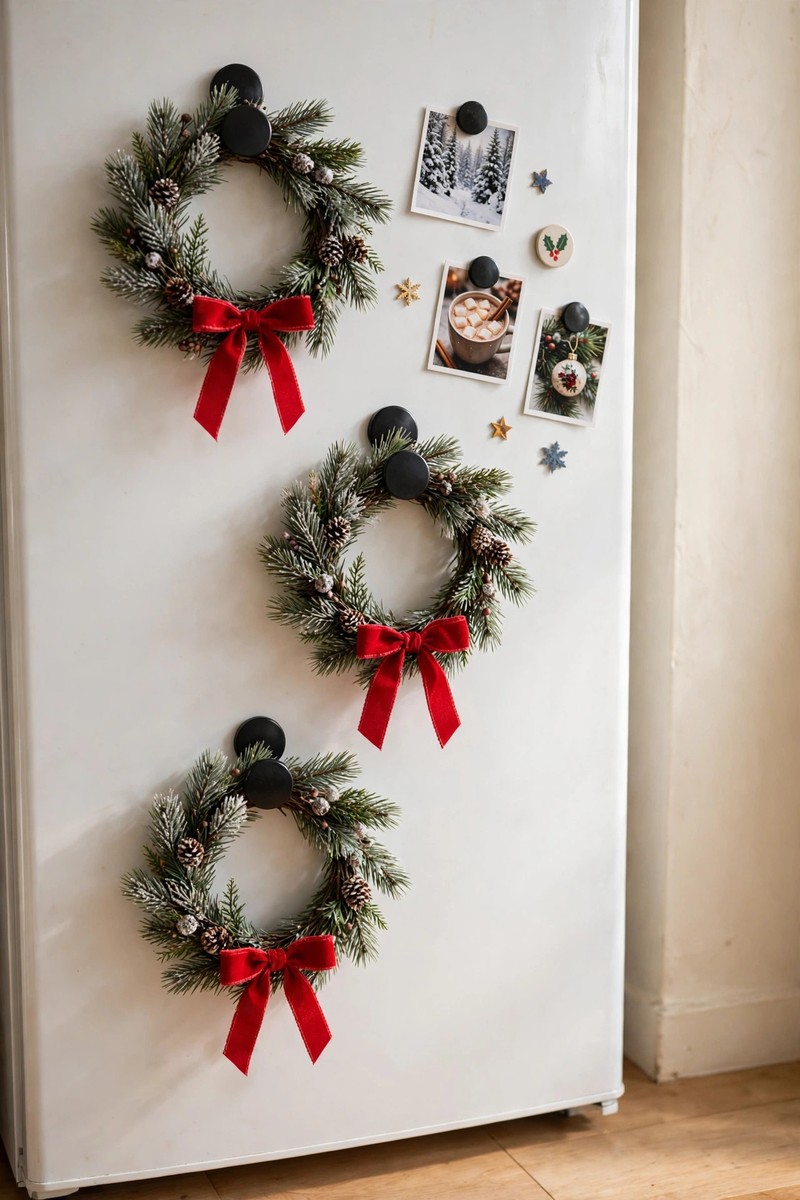
- Mini wreaths cost 3 to 6 dollars each, and strong magnets run about 5 dollars a pack.
- Two wreaths, one on each fridge door, look balanced and intentional.
- A red ribbon bow on each wreath adds color without extra decor.
- The magnets hold up to 2 pounds, so the wreaths stay put all month.
Mini wreaths on the fridge turn the biggest appliance in the kitchen into Christmas decor. Attach a strong magnet to the back of a pine wreath, stick it on the fridge door, and add a red ribbon bow for color. Mini wreaths cost 3 to 6 dollars each, and a pack of strong magnets runs 5 dollars. Two wreaths, one on each fridge door, look balanced and intentional, and a few holiday photo magnets beside them fill the space. The magnets hold up to 2 pounds each, so the wreaths stay put all month, with the door opening and closing.
The fridge wreath works because it uses a surface every kitchen has, and it takes 5 minutes to set up. Pick wreaths under 8 inches across, so they do not block the door handle or the ice dispenser. A wreath with red berries and a bow looks fuller than plain pine, and a fairy light is overkill, since the fridge has a light inside. In January, the wreaths come off in seconds, and the magnets go back in the drawer. Five minutes to hang, five seconds to remove, and the kitchen greets you every time you open the fridge.
Gingerbread Counter Scene

- A gingerbread house kit costs 12 to 25 dollars and builds in about an hour.
- Display it on a wooden board so icing drips stay off the counter.
- A candy cane fence and a gumdrop path make the scene look finished.
- A glass dome keeps the house safe from curious pets and little hands.
A gingerbread house turns the kitchen counter into a Christmas scene that smells like spice and sugar. Build a kit house in an hour, set it on a wooden board to catch icing drips, and decorate it with white icing snow, a candy cane fence, and a gumdrop path. Most kits cost 12 to 25 dollars and include the house pieces, icing, and candy. A pine sprig beside the board and a fairy light strand along the backsplash finish the display. The house becomes the centerpiece of the kitchen, and guests stop to admire it every time they walk in.
The gingerbread house lasts 2 weeks on the counter before the icing starts to soften, so build it in mid-December for peak Christmas week. A glass dome over the house keeps pets and little hands away, and it also keeps the icing from drying out too fast. If the house leans, prop it with a box behind it until the icing sets, which takes about 30 minutes. After the holidays, compost the house or toss it, and the board goes back in the cabinet. One hour to build, two weeks of charm, and a kitchen that smells like a bakery.
Gift Wrap Corner
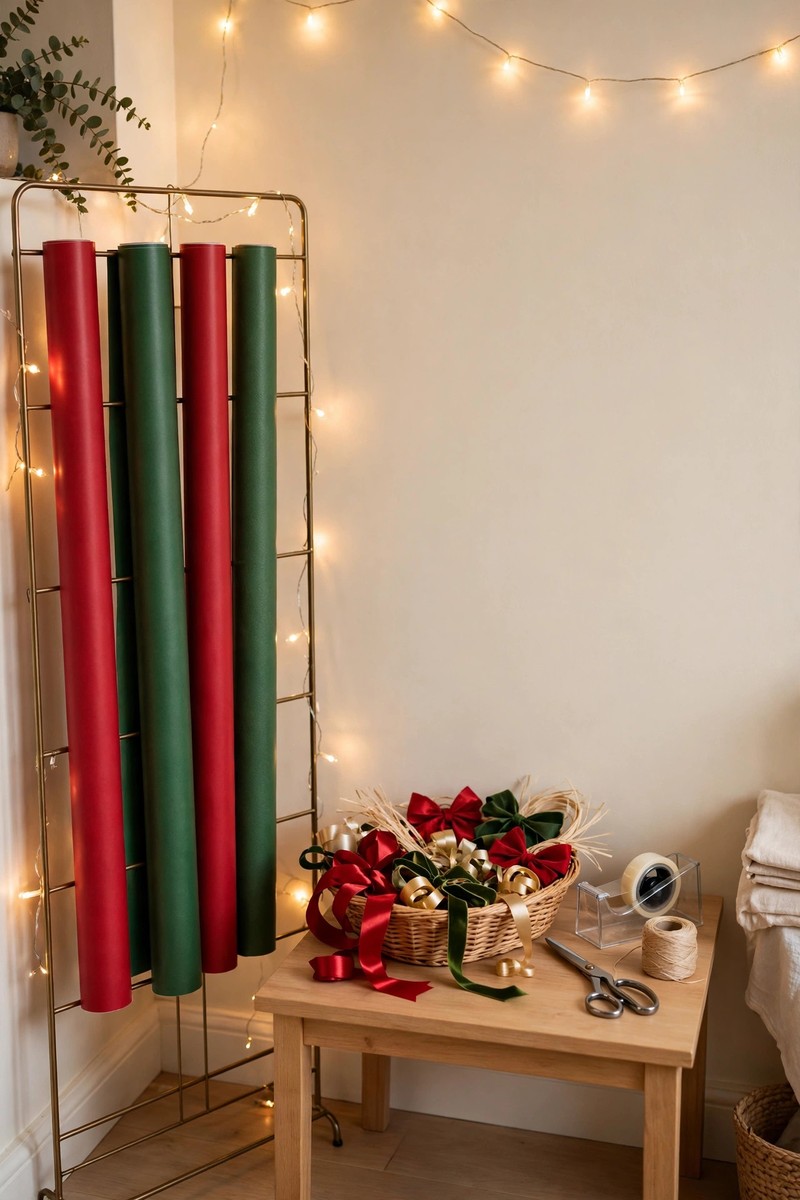
- A wrap station costs 20 to 40 dollars and uses about 3 square feet.
- A freestanding paper rack holds 6 rolls and fits in a corner.
- Keep ribbons, bows, scissors, and tape in one basket for easy access.
- Wrap gifts as they arrive, so Christmas Eve stays calm.
A gift wrap corner turns the December chore into a ritual, and it takes up less space than one basket. Set a paper rack in a corner, load it with 6 rolls of red, green, and kraft wrapping paper, and keep ribbons, bows, scissors, and tape in a basket on a table beside it. Most racks cost 20 to 40 dollars, and the station fits in 3 square feet. A fairy light strand along the wall makes the corner feel festive, and wrapping gifts as they arrive means Christmas Eve stays calm. No more wrapping on the floor at midnight.
The station works because everything lives in one spot, so wrapping a gift takes 5 minutes instead of 20. Keep the paper rolls upright in the rack, so they do not unroll across the floor, and store the tape and scissors in the basket, not in a drawer. A small table or a TV tray gives you a flat surface for cutting and folding. In January, the rack folds flat, the paper rolls go in a closet, and the corner is clear in about 10 minutes. One corner, one basket, and every gift looks like it came from a shop.
Holiday Reading Nook
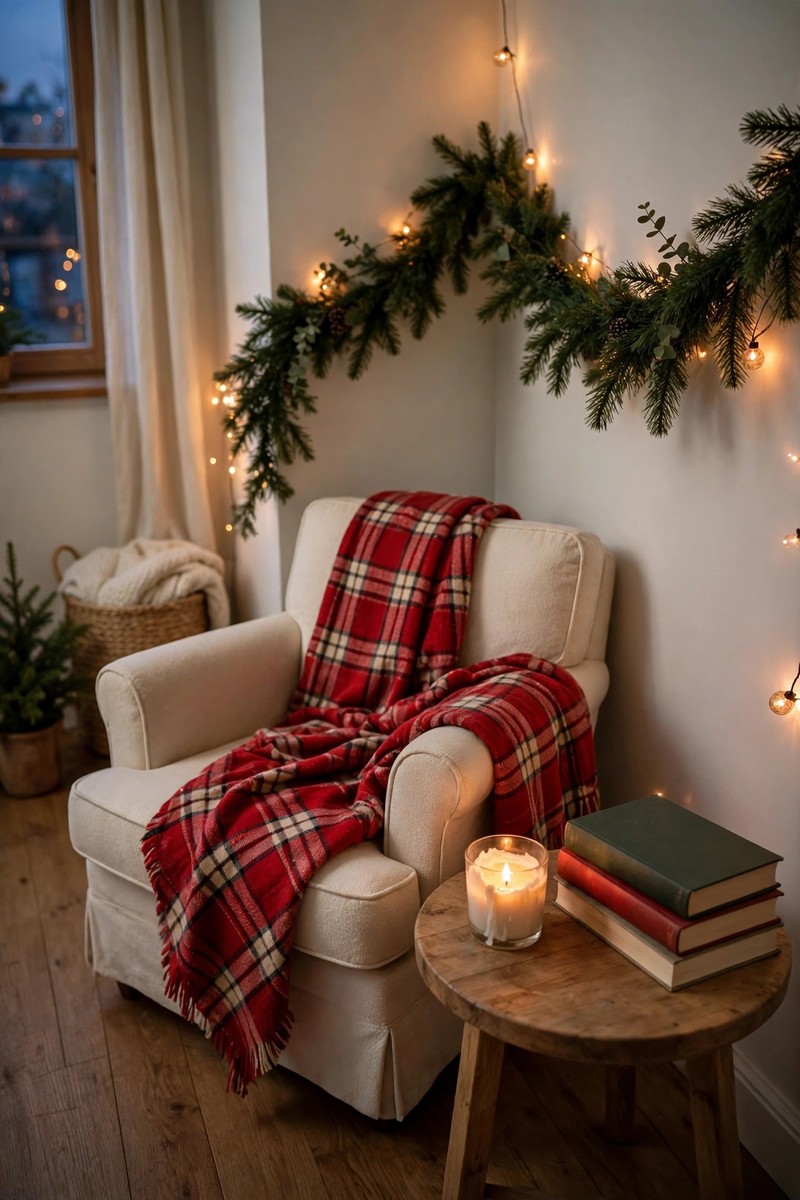
- A reading nook costs 30 to 60 dollars using pieces you already own.
- An armchair, a throw, and a small table are all you need.
- String lights along the wall replace a harsh overhead light.
- A stack of Christmas books on the table invites slow evenings.
A holiday reading nook turns a corner into the coziest spot in the apartment. Pull an armchair into a corner, drape a red plaid throw over the arm, and set a side table beside it with a candle and a stack of Christmas books. Nooks cost 30 to 60 dollars using pieces you already own, and a string of warm lights along the wall replaces the overhead light. A pine garland on the wall ties the corner to the rest of the room. The nook becomes the spot for cocoa, a book, and a quiet evening away from the TV.
The nook works because it is small and intentional, so it invites slow evenings instead of screen time. Keep the table clear except for the candle and the books, since clutter kills the calm. A battery candle matters here, because a real flame beside a throw blanket is a risk. Add a small basket of extra blankets nearby, so guests can curl up too. In January, the garland and lights come down, but the armchair stays, and the nook becomes a year-round reading spot. One corner, one chair, and December evenings slow down in the best way.
Frequently Asked Questions
How do you decorate a small apartment for Christmas without a big tree?
Use a tabletop tree, a wall tree, or a slim pencil tree, and put the holiday focus on garlands, lights, and table decor instead. A 2-foot tree on a side table gives you the same glow as a 7-foot tree in a quarter of the floor space. Add a garland on a shelf and a wreath on the door, and guests will not miss the big tree at all.
How do you hang Christmas decor without damaging the walls?
Use Command strips and hooks, over-door hooks, tension rods, and freestanding pieces, and skip nails and screws entirely. A medium Command hook holds 3 pounds, which covers most garlands and stockings. Warm the strip with a hair dryer for 30 seconds before peeling it off in January, and the paint stays clean.
How much does it cost to decorate a small apartment for Christmas?
Most renters spend 50 to 150 dollars on a full setup, and you can start with one 25-dollar idea and add more each year. Tabletop trees run 20 to 40 dollars, garlands 15 to 30 dollars, and string lights 10 to 20 dollars. Buy the big pieces after Christmas, when prices drop by half or more.
How do you store Christmas decor in a small apartment?
Store it in one clear bin that slides under the bed or onto a closet shelf, and keep the box count to one. Wrap ornaments in tissue paper, coil lights around a piece of cardboard, and label the bin so next December starts in minutes. A 30-quart bin holds a tabletop tree, two garlands, and a full set of ornaments.
Conclusion
Christmas in a small rental does not need a big tree or a big budget, just a few smart swaps that fit your space and your lease. These small apartment christmas decor ideas for renters prove that a tabletop tree, a bookshelf garland, and a door wreath can carry the whole season. Start with the one idea that makes you smile, add a second when you have an hour, and enjoy a home that smells like pine and glows at night. Save this guide on Pinterest, try one idea this weekend, and share it with a renter friend who needs the same holiday lift.
You Might Also Like
- 25+ Christmas Window Decorations You Can Put Up From Inside an Apartment (All From Inside)
- 25+ Winter Entryway Organization Ideas for Small Apartments (No Mud, No Mess)
- Start Here
- More Small Spaces Ideas
New guides land every week.